
Industries & Impact
Pump Impeller Replacement: Cast From a Worn Sample
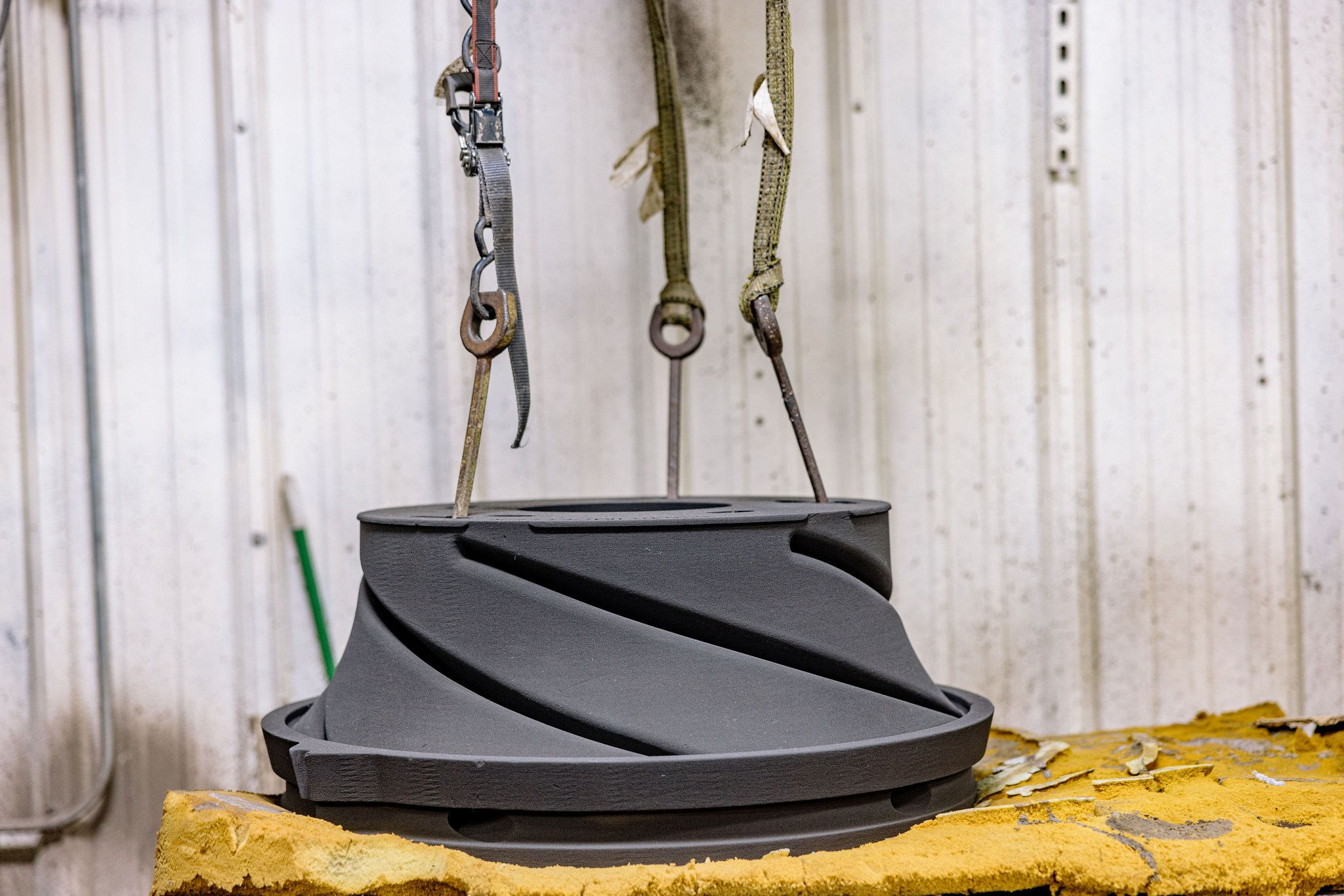
If your pump impeller is worn, cavitation-damaged, or obsolete and you do not have the original drawing, you do not need one. We 3D-scan the part, rebuild a CAD digital twin (restoring the worn vanes from unworn reference geometry), and pour an ASTM-spec replacement in stainless, duplex, ductile iron, or gray iron — typically 3–5 weeks end-to-end, no minimum order, no pattern tooling, USA-made.
Who this is for
This page is written for maintenance & reliability engineers, MRO planners, and procurement teams at industrial sites that run centrifugal pumps — water and wastewater, chemical and petrochemical, oil & gas, power generation, mining slurry, marine, and pulp & paper — and at the OEMs that build, service, and re-engineer them. If you have a worn or damaged impeller in front of you, the original supplier is gone or quoting an unworkable lead time, and you need 1 to a few dozen replacements with real engineering paperwork, the rest of this page tells you how it works.
The short answer to the title question
Yes, an impeller can be cast from a worn sample with no drawings. The route is reverse-engineering (3D scan to CAD digital twin) followed by patternless sand casting — a 3D-printed sand mold poured directly from the CAD, with no pattern tooling — in the right ASTM-spec alloy for the service. Lead time for a one-off or short-run impeller is typically 3–5 weeks rather than the 14–22 weeks of the traditional pattern-plus-pour path.
Why "no drawings" is not a blocker anymore
A generation ago, an impeller without an original drawing was a hard problem: a foundry needed a pattern, and a pattern needed a fully-toleranced 2D drawing or model to build from. Today the worn part itself is the source of truth. A blue-light or laser scanner captures the as-found geometry as a dense point cloud (typically tens of microns of accuracy on a part this size), and CAD reconstruction rebuilds the lost material — sharpening vane leading edges, restoring shroud thickness, and re-fairing the discharge tip — using unworn reference surfaces on the same part for guidance. See our 3D scanning & digital twin technical wiki and From broken part to digital blueprint for the underlying workflow we apply to every replacement.
If you do not even have the worn part — only photos and a few measurements off a similar unit — that is still workable but slower; please send everything you have and we will tell you what we can do.
Picking the alloy: a short field guide
Impeller and volute alloy choice is driven by the fluid, the service, and the failure mode of the part you are replacing. The grades we see most often:
- ASTM A743 CF8M / CF3M — cast 316 / 316L stainless steel. The workhorse for corrosive and food-grade centrifugal impellers and volutes. Good general corrosion resistance, weldable, repairable.
- ASTM A747 CB7Cu-1 — cast 17-4 PH precipitation-hardened stainless. Higher strength than CF8M; favored where cavitation, erosion, or higher shaft stress drives wear.
- ASTM A890 / A995 duplex stainless (CD4MCu, CD3MN, etc.) — for severe-service, chloride-rich, or seawater applications where standard 316 is not enough.
- ASTM A536 65-45-12 ductile iron — general non-corrosive water service and many industrial fluids. The cost-effective default when stainless is not required.
- ASTM A48 Class 30 / 35 gray iron — low-duty general service and some legacy bronze-replacement impeller designs.
- Nickel-aluminum bronze and other copper alloys — marine and seawater applications where biofouling and erosion-corrosion drive the choice.
If the original alloy is unknown, we identify it by optical-emission spectrometry on the sample and either match it or recommend an upgrade. See metals poured for the full alloy list we work in.
Realistic lead time, end-to-end
Published industry guidance puts standard iron- and steel-casting lead times in the 8–12 week range once tooling exists, with current US capacity constraints often pushing the queue further out (Urick: foundry lead-time analysis; CastingSource: lead times in the foundry industry). For an impeller, add another 6–10 weeks on the front end if a new pattern is required — and impeller patterns are not cheap, because the vane geometry and core boxes are non-trivial. That is the tooling cost, not the metal cost.
The patternless route collapses the pattern step. A typical short-run impeller schedule we run looks like this:
- Days 1–4. 3D-scan the worn impeller (and casing, if available). Rebuild the digital twin in CAD: restore worn vane leading edges and shroud surfaces, re-fair discharge geometry, model in balance pads. Confirm hub bore, key-way, and back-vane / pump-out vane geometry against the application.
- Days 4–8. Solidification simulation in MAGMA / NovaCast to find hot spots, shrink risk, and feed paths before any metal moves. The vane root and shroud-to-hub junction are the usual trouble spots. See solidification engineering.
- Days 8–18. 3D-printed sand mold built (or robotic-molded if quantity makes it worthwhile). Metal poured to the selected ASTM grade. Heat treatment as the grade requires — CB7Cu-1 typically aged to H1025 or H1075 depending on the strength target; duplex solution-annealed.
- Days 18–28. CNC machining of hub bore, key-way, mating shroud faces, and wear-ring areas to print on our in-house equipment. See CNC machining.
- Days 28–35. NDE per spec (LPI per ASTM E165 is standard on a finished impeller; MPI per ASTM E709 for ferromagnetic grades). Mechanical balancing to ISO 21940-11 G6.3 or G2.5. FAI dimensional. MTR issued. Final inspection and ship.
Many one-off and short-run impellers land in the 3–5 week range end-to-end. Larger impellers, more aggressive heat-treat routings, and tight balance grades push the longer end of that window. We give a real schedule on the quote, not a marketing one.
Tolerances and finish on an impeller casting
For sand-cast impellers, plan around general as-cast linear tolerances per ISO 8062-3 (typically grade DCTG 10–12 for parts this size class). That is fine for as-cast surfaces — the outside of the shrouds, vane outer profile, and back-shroud ribbing. It is not fine for hub bores, key-ways, wear-ring lands, or mating shroud faces — those get CNC-machined to print on our in-house equipment.
On a typical centrifugal impeller, the features we routinely finish-machine include the hub bore (to the shaft fit), key-way, lock-nut face, wear-ring lands on front and back shrouds (to the casing wear-ring clearance), and any sealing surface that mates to the back plate or bonnet. Vane leading-edge sharpness and the hydraulic surface finish on the vane passages are held to whatever the application requires — for high-cavitation or efficiency-critical service we can grind the vane surfaces to a specified Ra.
Balancing the cast impeller
Rotating-equipment balance matters as much as alloy choice. We balance to a specified grade — typically ISO 21940-11 G6.3 for general industrial pump service or G2.5 for higher-speed or vibration-critical applications — by removing material from designated balance pads modeled into the digital twin. Putting the balance pads in the CAD up front means material removal happens at a non-hydraulic location and does not change the pump curve. A balance report ships with the part.
NDE and the documentation that ships with the impeller
A short-run impeller is not "low documentation." A typical replacement ships with a real engineering paper trail:
- MTR (Material Test Report)
- Chemistry and mechanical properties for the heat, with the ASTM grade and applicable section confirmed. Tensile, yield, and elongation per the grade. For CB7Cu-1, hardness and aged condition (e.g., H1025) called out.
- FAI (First Article Inspection)
- Dimensional verification against the released model for the first piece (or representative piece) of the lot, in a PPAP-style format on request.
- NDE reports
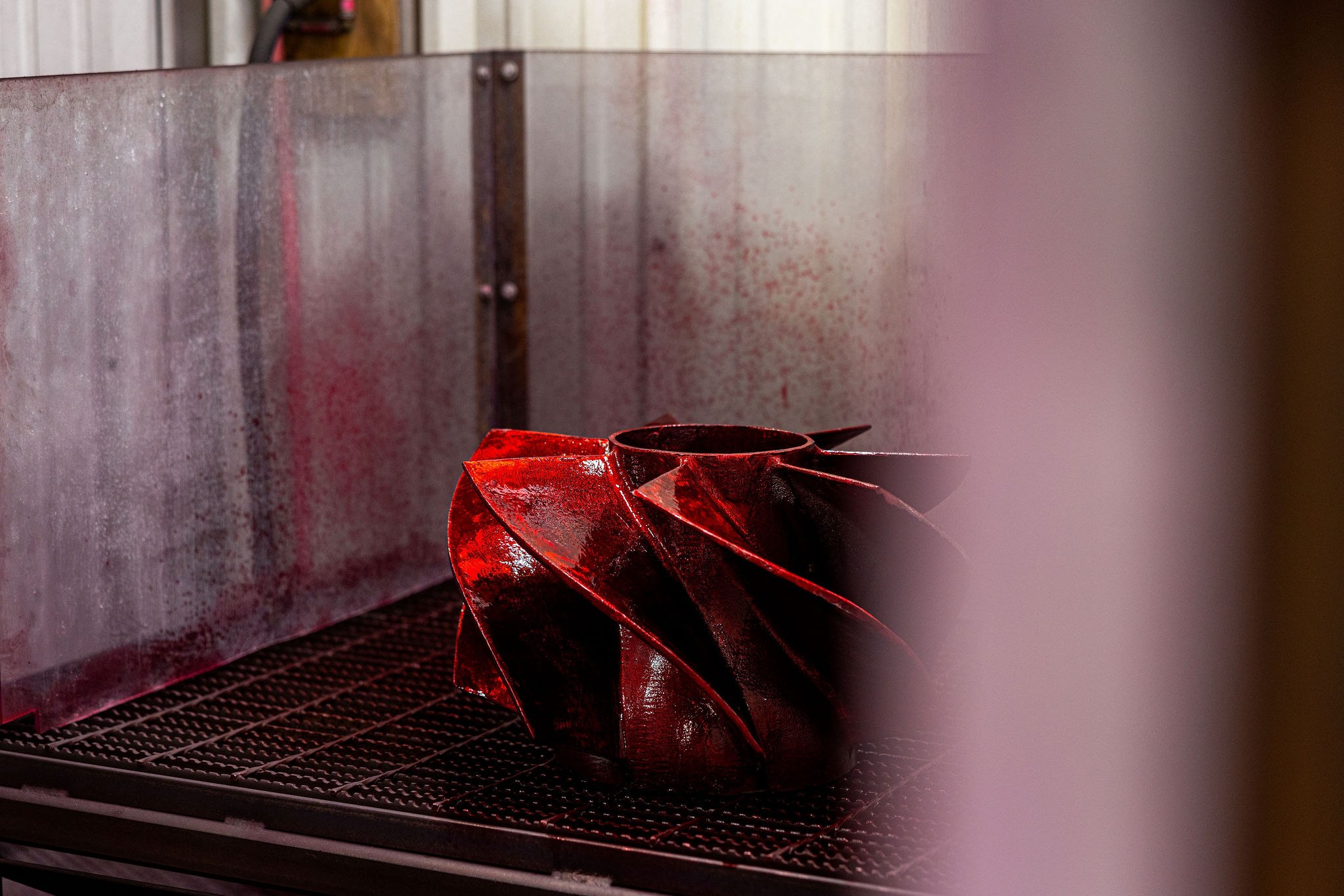
- Visual to MSS-SP-55 for stainless impellers; LPI per ASTM E165 on machined surfaces (standard on a finished impeller); MPI per ASTM E709 on ferromagnetic grades; radiography or UT for internal soundness when the spec calls for it.
- Balance report
- ISO 21940-11 grade (e.g., G6.3) and the residual unbalance after correction, with the balance speed and tolerance recorded.
- Heat-treat records
- Furnace charts and certifications for solution-anneal, age, or stress-relief routings that are part of the part's metallurgy.
NDE, machining, and balancing are performed in-house. See inspection & QC for the equipment list.
What to send us to get a quote moving
The faster you can put these in front of us, the faster we can quote — and the more accurate that quote will be:
- The part: the worn impeller (best) and, if available, the matching casing or wear rings. Photos are useful for first-look but no substitute for the part itself.
- Service conditions: fluid, temperature, pressure, suction conditions if known (cavitation history is a tell), shaft speed, expected duty cycle.
- Material: the ASTM grade or alloy callout if you have it. If you do not, we will identify the original by spectrometry and recommend a match or upgrade.
- Mating geometry: shaft diameter and key-way, casing wear-ring bore and clearance target, any bolt-circle or tie-down geometry that has to match an existing assembly.
- Quantity: one is normal here; tell us the realistic run and whether repeat orders are likely.
- Acceptance: required NDE level, balance grade, FAI / PPAP requirements, any pressure-test or run-test acceptance criteria.
- Schedule: when do you actually need the impeller on a truck. Downtime jobs are flagged and run hot.
You can send it over here and we will come back with a path, a real schedule, and a price.
Where this fits in our wider short-run flow-control work
This page covers pump impellers cast from a sample specifically. The same patternless workflow runs across the rest of the flow-control parts we make in low volume:
- Precision impeller casting and the 16-week tooling wait — the patternless case for impellers from existing CAD.
- Replacing a discontinued pump or valve casting when the OEM is gone — the obsolete-OEM angle on the same workflow.
- Low-volume ductile iron valve body casting — the procurement view for short-run valve bodies in A536.
- The patternless advantage for emergency replacements — the "line is down" version.
- Legacy part replication — the full capability page.
- Low-volume, high-complexity castings — capability overview.
Sources & standards
- ASTM A743 — Standard Specification for Castings, Iron-Chromium, Iron-Chromium-Nickel, Corrosion-Resistant, for General Application (covers CF8M, CF3M).
- ASTM A747 — Standard Specification for Steel Castings, Stainless, Precipitation Hardening (covers CB7Cu-1, the cast 17-4 PH grade).
- ASTM A890 — Standard Specification for Castings, Iron-Chromium-Nickel-Molybdenum Corrosion-Resistant, Duplex.
- ASTM A995 — Standard Specification for Castings, Austenitic-Ferritic (Duplex) Stainless Steel, for Pressure-Containing Parts.
- ASTM A536 — Standard Specification for Ductile Iron Castings.
- ASTM A48 — Standard Specification for Gray Iron Castings.
- ASTM E165 — Standard Practice for Liquid Penetrant Testing.
- ASTM E709 — Standard Guide for Magnetic Particle Testing.
- ISO 21940-11 — Mechanical vibration — Rotor balancing — Procedures and tolerances for rotors with rigid behavior.
- ISO 8062-3 — Geometrical product specifications (GPS) — Dimensional and geometrical tolerances for moulded parts — Castings.
- Urick Foundry — Production lead times in the foundry industry.
- CastingSource — Lead times: what it takes to get faster castings.
FAQ
Can you cast a pump impeller from just a worn sample, with no drawings?
Yes. We 3D-scan the impeller, rebuild a digital twin in CAD (digitally restoring worn vane leading edges and shroud surfaces from unworn reference geometry on the same part), and use that model as the source-of-truth for a patternless sand mold. If the original alloy is unknown, we identify it by optical-emission spectrometry and recommend a matching or upgraded ASTM grade. The original drawing is helpful but not required.
What ASTM grade should the replacement impeller be?
For corrosive service, ASTM A743 CF8M (cast 316) or CF3M (cast 316L) is the workhorse for centrifugal impellers and volutes. For high-cavitation or higher-strength service, ASTM A747 CB7Cu-1 (cast 17-4 PH) is common. For severe-service or seawater, ASTM A890 / A995 duplex grades (CD4MCu, CD3MN) are specified. For general non-corrosive service, ASTM A536 65-45-12 ductile iron is the cost-effective default; ASTM A48 Class 30 gray iron is sometimes used in low-duty service. We pour all of these.
How long does a one-off pump impeller casting take?
Traditional foundries quote 8–12 weeks once tooling exists, plus another 6–10 weeks if a pattern must be built. Patternless casting (3D-printed sand molds direct from CAD) removes the pattern step entirely. Many short-run impeller jobs run 3–5 weeks from approved CAD through final inspection and balancing.
Can you cast the volute or casing from a sample too?
Yes. The same scan → digital twin → patternless mold workflow applies to the volute, suction cover, back plate, and wear rings. Matching the impeller and casing as a pair matters — wear-ring clearances, cutwater geometry, and tongue position all interact with the impeller geometry. We will scan and rebuild the mating surfaces together when the as-found set is available.
How do you handle impeller balancing on a cast replacement?
We balance to a specified grade — typically ISO 21940-11 G6.3 or G2.5 depending on shaft speed and the pump's vibration spec — by removing material from designated balance pads on the shrouds. The CAD model is built with the balance pads in the right places so material removal does not affect hydraulic performance. Balance reports ship with the part.
Can you upgrade the alloy at the same time — say from cast iron to stainless?
Yes, and it is a common ask on cavitation- or corrosion-damaged impellers. Upgrading from ductile iron to CF8M or to 17-4 PH typically requires no geometry change, though a few features (e.g., key-way or hub bore) may need to be re-toleranced for the new alloy's machining behavior. We will flag any of that in the DFM review before we pour.