
Industries & Impact
How Short-Run Casting Pricing Works at a No-Minimum US Foundry
Short-run casting pricing at a no-minimum US foundry breaks into six line items: poured weight, alloy family, geometry and cores, tooling, machining, and the NDE and MTR package. The dominant hit on a traditional one-off is pattern tooling — a physical pattern and core boxes built in wood, urethane, or metal before the first pour, often $3,000 to $30,000 and 6 to 16 weeks. Patternless 3D-sand-printed molding removes that line item entirely, which is why a quantity of one at One Off Castings is priced against the actual work of making the part instead of against a batch minimum. This page walks each line item so you can read a short-run quote — and know what to send us to get a real number back.
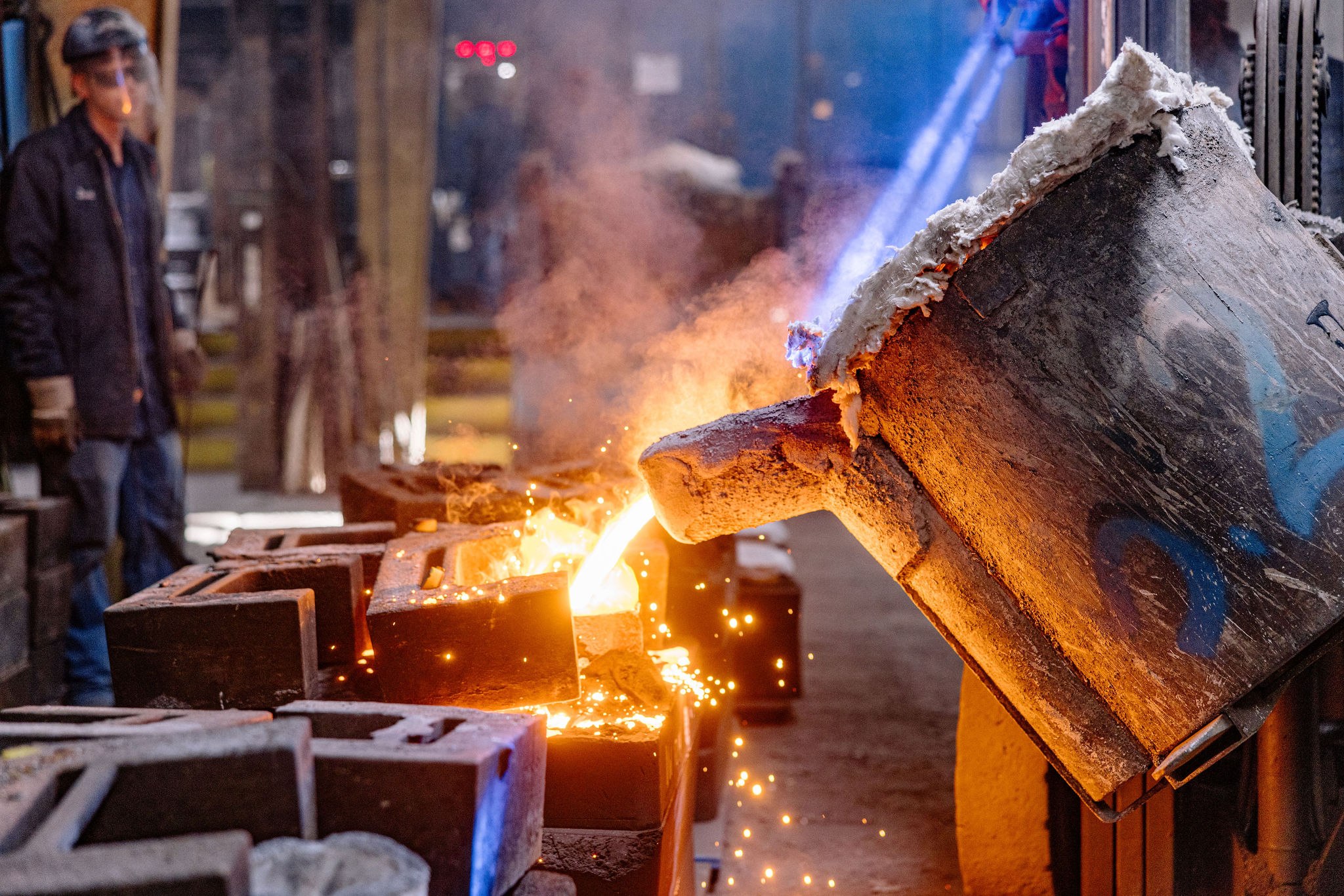
Who this is for
You are an engineer, buyer, or maintenance planner scoping a 1-to-100-piece cast part and you want to understand what actually shows up on the quote before you send the RFQ. Maybe you are replacing a discontinued pump housing, a cracked valve body, a worn gearbox, or a legacy compressor cylinder. Maybe you need one prototype casting in a real production alloy before you commit to tooling. Either way, you want to know why a short-run patternless quote is priced the way it is, why "no minimum" does not mean "free," and where the money actually goes. That is what this page is about — engineer-to-engineer, no sales pitch.
The short answer — the six line items in a short-run quote
A short-run casting quote is built from six drivers. Nothing else moves the number materially:
- Poured weight. The metal in the finished part plus the gating, risers, and feeders needed to fill and feed it soundly.
- Alloy family. Iron, steel, stainless, duplex, or aluminum — cost per pound and processing cost climb accordingly.
- Geometry, walls, and cores. Thin walls, internal passages, undercuts, and every core the mold needs.
- Tooling. Physical pattern and core boxes on a traditional route; effectively zero on the patternless route.
- Machining. Every bore, sealing face, bolt circle, and shaft fit that has to be held to a print tolerance.
- NDE, MTR, and inspection. The acceptance package — dye penetrant, magnetic particle, radiography, ultrasonic, PMI, first article, and the material test report.
Quantity moves how the fixed engineering and setup hours divide across pieces, but it does not change the physics of any single line item above. So a 1-to-100-piece quote is built line-by-line, and this article walks each one.
Line item #1 — poured weight
You pay for the metal in the finished part and for the gating, risers, and feeders that are poured with it. On a short run, poured weight is often 130 to 180 percent of finished weight because a small run cannot amortize aggressive yield-optimization the way a hard-tooled production run can. Solidification simulation in MAGMASOFT and NovaCast tightens that ratio wherever it can — it engineers feeding on the screen so the risers do what they have to do without being oversized "just in case."
Line item #2 — alloy family
Cost per pound rises with alloy content and processing complexity. In rough per-pound order for the grades we pour: gray iron (ASTM A48) and ductile iron (ASTM A536) sit at the base; austenitic ductile iron (ASTM A439 D2) steps up; carbon and low-alloy steel (ASTM A216 WCA/WCB/WCC) steps up again; low-temperature steel (ASTM A352 LCB) and martensitic stainless (ASTM A487 and A743 CA6NM or CA15) sit above that; austenitic stainless (ASTM A351, A744 CF8M / CF3M) is higher again; and duplex stainless (ASTM A890 / A995 CD4MCuN) and aluminum (ASTM B26) round out the range. See the full metals-poured list for exact grades and classes.
The alloy also drives the heat-treatment path. Duplex has to be solution-annealed and rapidly water-quenched per A890 / A995. CA6NM is normalized and then double-tempered. WCB is normalized-and-tempered or quench-and-tempered to hit the mechanicals. Austenitic stainless is solution-treated. Every one of those is furnace time on the quote, and none of it disappears at quantity one.
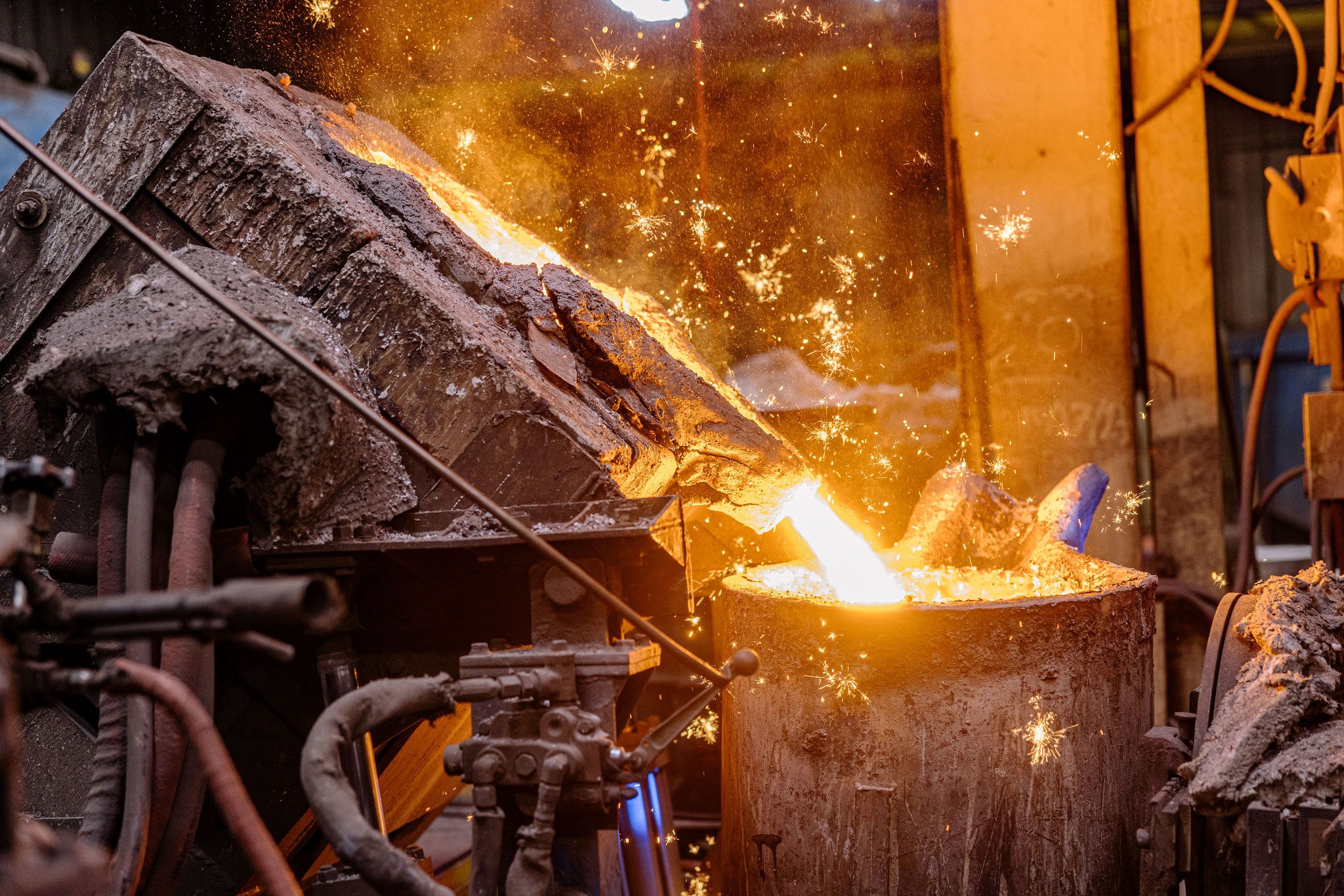
Line item #3 — geometry, walls, and cores
Thin walls, deep pockets, internal passages, and undercuts drive the number of sand cores and the complexity of the mold. Every core is a piece to print, set, and inspect. A simple bracket is cheap to mold; a manifold with internal galleries, a pump volute with a full-round waterway, or a valve body with a cored bonnet cavity is not — the mold is more expensive, the assembly is more labor, and the risk of a hidden defect climbs, which in turn raises the required NDE. On patternless, cores print alongside the mold in the same job, which flattens the labor side of that curve compared with molding cores from separate core boxes — but the design and print cost still scales with core count and complexity.
Line item #4 — tooling, and the honest math on patternless
This is the line item that changes the whole picture on a quantity of one. A conventional sand casting needs a physical pattern and often core boxes, built in wood, urethane, or metal, before the first pour. That is real money — commonly $3,000 to $30,000 depending on size and material — and 6 to 16 weeks of pattern build before any metal moves. On a run of ten thousand it is a rounding error per piece. On a run of one, it is the whole quote.
Patternless removes it. The 3D-printed sand mold is generated straight from your CAD, in the same shop, in the same week, with no pattern shop and no core-box build. What that does not mean is "free" — you still pay for the printed sand and binder, for the print time, for the digital gating-and-risering design, and for the simulation run that engineered the feeding. What it does mean is that the pattern-tooling amortization line — the dominant hit on any traditional quantity-of-one — effectively goes to zero. That is the mechanism, not marketing: robotic molding and patternless printing replace the pattern step, not the engineering step. See our companion article on what a one-off casting costs for the full cost-driver breakdown.
Line item #5 — machining
As-cast surfaces hold general tolerances per ISO 8062-3, commonly grade DCTG 10 to 12. Any feature that has to fit — bores, shaft fits, bolt circles, keyways, sealing faces, gasket registers — is CNC-machined to your print on our in-house equipment. The line item is straightforward: hours of setup plus hours of cut, times the shop rate, times a modest allocation for the fixture and program. The more critical features called out and the tighter the tolerance, the more machining time on the quote. Call the machined features out up front — it is the single biggest source of quote-to-quote drift.
Line item #6 — NDE, MTR, and the acceptance package
A bare visual-per-MSS-SP-55 casting with a chemistry report is the cheap end of the acceptance range. Adding liquid penetrant (ASTM E165), magnetic particle (ASTM E709), radiography (ASTM E94), ultrasonic testing (ASTM A609), PMI, or a first-article inspection each adds a real line item — not a surprise, but real hours. An EN 10204 3.1 MTR ties chemistry, mechanicals, and heat-treat record to your part's heat and is standard on engineering-grade work. Spec the acceptance level you actually need — over-speccing NDE is a common way engineers accidentally inflate a short-run quote.
How quantity moves the number in a 1-to-100 book
The fixed engineering and setup hours — CAD prep, gating and risering design, simulation, first-article inspection — get allocated across the run, so per-piece cost drops as quantity climbs. Practical shape of the curve inside a 1-to-100 book: quantity one bears the whole fixed allocation, so the per-piece price is the highest point on the curve. A run of ten typically shows a meaningful per-piece drop from quantity one because those fixed hours divide by ten. From ten to fifty the curve flattens because setup is dominated by molding and machining, both of which scale nearly linearly. By fifty to a hundred you are close to a stable per-piece rate. Above 500 pieces per year running indefinitely, hard-tooled sand casting typically wins per-piece — we will tell you so and route accordingly, which is a different economic calculation than the annual-crossover figures often cited by the SFSA.
What "no minimum order" really means
Three things it means at an engineering-grade foundry, and three it does not.
What it means: (1) a quantity of one is priced and scheduled the same way any other job is — line-item by line-item — not as a favor and not against a minimum you have to clear; (2) the shop is set up for it: patternless molding, in-house heat treatment, in-house CNC, in-house NDE, and standardized short-run engineering and inspection paths; (3) you can order one now and repeat later on demand because the geometry lives as a digital model rather than a physical pattern that has to be dug out of storage.
What it does not mean: (1) the price of one part matches the per-piece price of a fifty-piece run — the fixed engineering allocation is still real; (2) there is no engineering and setup work — every one-off still gets CAD prep, gating and risering design, and simulation; (3) the foundry is a fit for hobby, decorative, or novelty pours — no minimum, but also not the right shop for a keychain or a jewelry piece.
When short-run patternless pricing is the right fit — and when it is not
Short-run, no-minimum, patternless pricing is a strong fit when you are:
- Maintenance or reliability (MRO). A downtime-critical or obsolete part, OEM slow, expensive, or gone, one certified replacement needed fast. See replacing a discontinued pump or valve casting and broken or cracked cast part replacement from sample or scan.
- Engineering / R&D. One prototype casting in a real production alloy to test fit, function, or machining before committing to hard tooling.
- Short bridge run. A 5-to-25 piece batch that keeps a line running while permanent tooling is built somewhere else.
- Legacy replacement without drawings. Reverse-engineered from a physical sample, a 3D scan, or clear photos — see what your scan file needs to contain and reverse-engineered wear-part replacement.
It is not the right fit when you need 500-plus pieces a year running indefinitely (hard-tooled wins per-piece), when the requirement is an ASME U-stamp or API monogram on the finished assembly (those live at the assembler / OEM, not on the foundry line), when the part is hobby / decorative / novelty (this is engineering-grade industrial work), or when the only requirement is "cheapest possible with no spec" (a short-run engineering quote is not going to beat an offshore commodity price and does not try to). We will say so up front.
What to send us for a real short-run number
- The part or a 3D model. A STEP or IGES CAD file if you have one, or a clean STL. If there is no model, a physical sample or clear photos with key dimensions is fine — we can reverse-engineer from any of those. See legacy part replication.
- Alloy or service conditions. The ASTM grade if you know it. If you do not, describe the service (fluid, temperature, pressure, wear mode, corrosion mode) and we call the grade. If the original alloy is unknown, ship a coupon — we identify it in-house via optical-emission spectrometry.
- Critical features. The bores, sealing faces, bolt circles, keyways, and fits that must be machined to a tolerance, called out up front.
- NDE and documentation. The acceptance level you actually need — LPI / MPI / RT / UT / PMI and the MTR level (EN 10204 2.2 or 3.1) and any FAI requirement.
- Quantity and schedule. Quantity one is normal; tell us if repeat orders are likely so we can quote the batch too. Give the real deadline — downtime jobs are flagged and run hot.
Send it over here and we will come back with a real path, a real schedule, and a real number line-by-line — not a minimum you have to clear before we will talk.
Related reading
- How much does a one-off metal casting cost? — the seven cost drivers on a single-part quote.
- Can I get a single one-off casting, no minimum, in the US? — the "yes, one is normal" sibling.
- CF8M vs A216 WCB cast valve body — when to spec which.
- CA6NM vs CA15 cast martensitic stainless — when to spec which.
- Low-volume CF8M stainless casting — what to expect.
- Low-volume duplex CD4MCuN, no minimum — what to expect.
- Lead times for a replacement casting when a line is down.
- Made-in-USA domestic-melt replacement castings for obsolete parts.
Sources & standards
- ASTM A48 — Gray iron castings.
- ASTM A536 — Ductile iron castings.
- ASTM A439 — Austenitic ductile iron castings (D2).
- ASTM A216 — Carbon steel castings for fusion welding (WCA/WCB/WCC).
- ASTM A352 — Low-temperature steel castings (LCB).
- ASTM A487 — Steel castings for pressure-containing parts (CA6NM, CA15).
- ASTM A351 — Castings for high-temperature service (CF8M, CF3M).
- ASTM A743 — Corrosion-resistant iron-chromium-nickel castings.
- ASTM A744 — Corrosion-resistant castings for severe service.
- ASTM A890 / A995 — Duplex stainless castings (CD4MCuN).
- ASTM B26 — Aluminum-alloy sand castings.
- ASTM E165 — Liquid penetrant testing.
- ASTM E709 — Magnetic particle testing.
- ASTM E94 — Radiographic examination.
- ASTM A609 — Ultrasonic examination of castings.
- MSS-SP-55 — Visual method for steel casting surface acceptance.
- ISO 8062-3 — Dimensional and geometrical tolerances for cast parts.
- EN 10204 — Metallic products inspection documents (2.2 / 3.1 MTR).
- Steel Founders' Society of America (SFSA) — Cast steel industry reference.
FAQ
Is there really no minimum order?
Yes. A single casting is a normal order here, not a favor. The whole shop is set up for 1-to-100-piece work — engineering, patternless molding, melt, heat-treat, machining, and inspection all run on a schedule built around short runs. A quantity of one is priced and scheduled the same way a quantity of fifty is: line-item by line-item, not against a minimum you have to clear before we will talk.
If there is no minimum, why is a single part still not "cheap"?
Removing the minimum removes the batch penalty, not the cost of making the part. A single casting still has to cover engineering and CAD prep, solidification simulation, the printed sand mold, the melt and pour, heat treatment, CNC machining of critical features, and the inspection and MTR package. Those are real work, and they do not disappear at quantity one — they just are not multiplied against a big minimum. The saving on quantity one comes from eliminating the pattern-tooling charge, which is often thousands of dollars and 6-to-16 weeks of pattern build at a traditional foundry.
What line items are actually in a short-run casting quote?
Six main buckets: (1) poured weight — the metal in the finished part plus the gating, risers, and feeders needed to fill and feed it soundly; (2) alloy family — gray iron and ductile iron are the most economical per pound, carbon and low-alloy steel step up, and stainless and duplex step up again; (3) geometry, wall sections, and cores — thin walls, internal passages, and undercuts drive core count and mold complexity; (4) tooling — a physical pattern at a traditional foundry, effectively zero on the patternless route; (5) machining — every fit, bore, sealing face, and bolt circle held to a tolerance is CNC time; (6) NDE, MTR, and the acceptance package — LPI, MPI, RT, UT, PMI, and the material test report are priced by scope. Quantity moves the fixed engineering and setup allocation across pieces, but it does not change the physics of any single line item.
Does patternless 3D sand printing really remove the tooling cost?
It removes the physical pattern-and-core-box line item, which is the dominant hit on a traditional one-off. It does not remove the digital work — CAD prep, gating and risering design, and solidification simulation are still real hours in the quote, and the printed sand molds and cores themselves are a real material cost. What actually happens on a patternless one-off is that the pattern-tooling charge that would have been $3,000 to $30,000 (and 6-to-16 weeks) at a traditional foundry effectively goes to zero, so the price of a single casting drops to the true cost of engineering plus one mold plus one pour plus finishing — instead of one-of-a-kind plus a full pattern amortized against a run of one.
What alloys can you pour on a short-run, no-minimum basis?
Gray iron (ASTM A48), ductile iron (ASTM A536 in all four common grades), austenitic ductile iron (ASTM A439 D2), carbon and low-alloy steel (ASTM A216 WCA/WCB/WCC), low-temperature steel (ASTM A352 LCB), martensitic stainless (ASTM A487 and A743 CA6NM and CA15 in Class A or B), austenitic stainless (ASTM A351, A743, and A744 CF8M and CF3M), duplex stainless (ASTM A890 and A995 CD4MCuN), and aluminum (ASTM B26). If the original alloy of a legacy part is unknown, in-house optical-emission spectrometry on your sample identifies it and picks the closest ASTM grade — or upgrades it if the service calls for it.
How much does quantity actually move the number in a 1-to-100 book?
The fixed costs — engineering, CAD prep, simulation, first-article inspection — get spread across the run, so per-piece cost drops as quantity climbs, but it is not the cliff you see when you compare quantity one against a hard-tooled run of ten thousand. Practical rule of thumb inside a 1-to-100 book: quantity one bears the whole fixed allocation; a run of ten typically shows a meaningful per-piece drop from quantity one because those fixed hours divide by ten; from ten to fifty the curve flattens; by fifty to a hundred you are close to a stable per-piece rate. Above 500 pieces per year running indefinitely, hard-tooled sand casting starts to win per-piece and we will say so.
What information do you need to give me an accurate short-run price?
A CAD model (STEP, IGES, or a clean STL) or a physical sample / clear photos with key dimensions if there is no model; the ASTM grade or the service conditions if the grade is unknown; the critical features that must be machined to a tolerance (bores, sealing faces, bolt circles, keyways); the required NDE (LPI per ASTM E165, MPI per E709, RT per E94, UT per A609) and any documentation (EN 10204 3.1 MTR, FAI, PMI); the quantity and the schedule. The more of that we have up front, the tighter and faster the number comes back.
When is short-run patternless pricing not the right fit?
When you need 500-plus pieces a year running indefinitely — hard-tooled sand casting is cheaper per piece at that volume and we will route you to that path. When you need a hobby or decorative piece, jewelry, or a novelty pour — this is engineering-grade industrial casting, priced accordingly. When you need a pressure vessel with an ASME U-stamp, an API-monogrammed valve assembly, or a nuclear N-stamped part — those stamps live at the assembler / OEM, not on the foundry line. When your only requirement is "cheapest possible with no spec" — a short-run engineering-grade quote is not going to beat an offshore commodity price, and it is not trying to.