
Industries & Impact
Pump Volute & Casing Replacement — Cast from Sample or Scan
Worn or cracked pump volute or casing on an obsolete pump the OEM no longer supports? Send it. We 3D-scan the sample, rebuild the hydraulic passage from unworn reference geometry, identify the parent alloy in-house by spectrometry, and pour an ASTM-spec replacement — ductile iron A536, carbon steel A216 WCB / WCC, austenitic stainless A351 / A743 CF8M or CF3M, martensitic stainless A487 / A743 CA6NM or CA15, duplex A890 / A995 CD4MCuN — from a patternless 3D-printed sand mold. 1–50 pieces, no minimum, 3–5 weeks. Independent US foundry, not tied to any pump OEM.
Who this page is for
This page is written for MRO and reliability engineers, maintenance planners, and sourcing at industrial pump operators — gas plants, refineries, chemical process, water and wastewater utilities, hydro and thermal power, marine and dredging, mining and mineral processing — with a worn or cracked volute or pump casing in front of them and often no OEM left to call. Pump-rebuild shops quoting a 1–50 piece replacement run on a legacy pump family are in scope; design engineers at pump OEMs specifying a low-volume cast volute on a new or rebuilt platform are in scope. Hobbyists, one-piece novelty buyers, and high-volume commodity price-shoppers are not, and this page will make that clear before the quote conversation starts.
The short answer
Yes — a worn or cracked pump volute or casing can be reverse-engineered into an ASTM-spec cast replacement without original drawings, in the alloys and quantities MRO buyers actually need. The workflow: scan the worn casing, recover the as-new hydraulic passage from unworn reference geometry (cast draft, discharge flange, mating impeller and cover), identify the parent alloy by optical-emission spectrometry, choose the ASTM grade appropriate to the service, and pour from a patternless 3D-printed sand mold. From a released CAD, plan on 3–5 weeks to finished, machined, inspected castings with a Material Test Report; add 1–2 weeks up front when we are reverse-engineering from a sample. Quantity range that fits patternless economics is 1 to 100 pieces per campaign (Steel Founders' Society of America — 3D sand printing overview).
Pump wet-end parts in scope
What we routinely cast on short-run reverse-engineered pump work, framed by function rather than by any specific pump brand:
- Single-suction and double-suction volute casings — the primary pressure-containing casting on end-suction, split-case, and between-bearing centrifugal pumps.
- Multi-stage diffuser and interstage bowls — vertical turbine and horizontal multi-stage pump internals.
- Slurry pump wet-end volutes and suction liners — sacrificial hydraulic surfaces on mining, dredge, and process slurry service; martensitic and duplex stainless territory.
- Hydro turbine volutes and spiral casings for small-hydro applications — martensitic stainless CA6NM is the standard alloy.
- Seal-chamber and stuffing-box housings that bolt to the volute on rebuild campaigns — often replaced alongside the volute itself.
- Suction covers, discharge covers, and end plates — the closing castings on the wet end.
- Impellers when the rotating side is being renewed at the same time — the full workflow lives on our pump-impeller replacement page.
What we honestly do NOT pour — and why we say so up front
A handful of pump-casing alloys sit outside our metals-poured list. If your drawing calls for one of these, we will say so on the first call and help route the RFQ.
- ASTM A352 LC2, LC3, LC4 cryogenic carbon steel
- Impact-tested low-temperature carbon steel for LNG, ethylene, and cryogenic-service pump casings. Requires specialty melt practice and Charpy V-notch acceptance at –46 °C to –101 °C; not on our pour list.
- ASTM A297 / A608 heat-resistant Cr-Ni
- High-temperature centrifugally- or statically-cast heat-resistant grades for furnace and reformer-service pumps and mixers. Specialty heat-resistant foundries are the right vendor.
- Nickel-base severe-corrosion alloys
- Alloy 20 (CN7M), Hastelloy C-276, Inconel 625 and 725 pump volutes for hydrometallurgy and severe-corrosion chemical service. Requires nickel-base melt practice we do not run; goes to Ni-base specialty foundries.
- ASTM B584 / B148 copper-alloy bronze wet ends
- Bronze pump volutes and impellers for potable-water, marine, and some chemical service. Non-ferrous specialty foundries pour these.
Everything else on our pour list is fair game — the ductile-iron, gray-iron, cast-carbon-steel, austenitic-stainless, martensitic-stainless, and duplex-stainless grades below cover a large share of the pump volute and casing work MRO buyers actually need to replace on legacy pumps.
Alloy decision — matching the ASTM grade to the pump service
The right alloy comes from the service, not the pump brand. The alloys we routinely pour for volute and casing work, with when each fits:
- ASTM A536 ductile iron — 65-45-12 and 80-55-06
- The default for general municipal water, HVAC circulator, and low-severity industrial pump volutes. Machinable, castable in thick sections with heavy pressure ribbing, and the standard grade on many legacy end-suction and split-case volute drawings. Higher-strength 100-70-03 is available on the pour list when the pressure ratings step up (Ductile Iron Society — ductile iron property data).
- ASTM A48 gray iron — Class 30 or 40
- Light-duty legacy municipal-water and low-pressure industrial pump casings. Damping and machinability are excellent; pressure and impact ratings are lower than ductile. Not the choice for anything approaching modern ANSI B73.1 pressure ratings.
- ASTM A216 WCB or WCC carbon steel
- Cast carbon steel volutes for higher-pressure, higher-temperature general-industrial pump service — refinery, gas plant, process water. Weldable and repairable in the field; stress-relieved after pour and rough machining.
- ASTM A351 or A743 / A744 CF8M austenitic stainless
- Molybdenum-bearing austenitic stainless — the standard chemical-pump volute alloy. Good general corrosion resistance and pitting resistance; not a wear alloy. A351 CF3M / A743 CF3M is the low-carbon variant for weldability-sensitive service.
- ASTM A487 or A743 CA6NM martensitic stainless
- Air-hardenable martensitic stainless with cavitation resistance — the standard hydro-turbine, dredge-pump, and mining slurry pump wet-end alloy. Air-hardens to the mid-40s HRC after solution and temper; survives cavitation and wet-abrasion service far longer than an austenitic stainless.
- ASTM A487 or A743 CA15 martensitic stainless
- Lower-alloy martensitic stainless with a similar service envelope to CA6NM at reduced cost. A cost-appropriate choice where CA6NM is over-spec for the service.
- ASTM A890 / A995 CD4MCuN duplex stainless
- Duplex stainless for chloride-heavy service — coastal seawater, brine, chloride slurry, and marine dredge volutes. Two-phase austenitic-ferritic microstructure resists pitting and stress-corrosion cracking where CA6NM would fall short. A995 is the pressure-rated variant.
- ASTM A439 D2 austenitic ductile
- Ni-alloyed austenitic ductile for corrosion-plus-moderate-wear service where a stainless is over-spec but a standard A536 is under-spec — some chemical circulator and caustic-service volutes.
Not sure which grade to name on the drawing? Our specifying an ASTM grade page walks the A216 / A536 / A743 decision framework in more depth, and ductile iron vs gray iron covers that specific call.
Recovering the hydraulic passage — the critical geometry step
The single hardest problem on volute reverse-engineering is that the hydraulic wall is the part of the sample you cannot trust. Cavitation pitting, wet abrasion, and chloride corrosion have all moved the wall away from the as-designed passage. Casting from a scan of the worn passage gives you a worn volute in fresh metal, with permanently reduced hydraulic head. The disciplined recovery path uses three sources of unworn reference geometry on the sample itself:
- Unworn features on the same casting. Cast draft angles on the outer shell, the discharge-flange face and bolt pattern, the suction-nozzle geometry, the seal-chamber bore, mounting-foot pads, and cast letters and part numbers on the shoulder — none of which see hydraulic wear — carry the original as-new dimensions and drive the CAD rebuild.
- Symmetry of the volute cutwater and tongue. The tongue clearance and the throat area are symmetric about the discharge centerline; one side of the volute is usually less worn than the other, and the less-worn side sets the datum for the more-worn side.
- The mating impeller, cover, and stuffing-box housing. These parts geometrically define the as-new hydraulic envelope the worn passage has to be restored back to — the impeller vane tip circle sets the base-circle diameter, the cover face sets one end of the volute width, and the stuffing-box housing sets the seal-chamber datum.
A deviation-analysis color map of the scan against the restored CAD is generated before the mold is committed, so the reliability engineer signing off on the FAI can see exactly which hydraulic surfaces the rebuild recovered and which mounting features were carried through in the worn state on purpose. If the sample is worn past a recoverable reference — a heavily cavitated cutwater with a broken tongue, or a slurry-service volute worn through the shell — we say so on the first call and ask for a less-worn sibling from the site inventory or the mating impeller and cover. See our reverse-engineering pillar page for the full scan-to-CAD workflow and our scan-file requirements page for what to send if you already have the scan.
Volute-specific DfM — walls, cutwater, tongue, and machined interfaces
Pump volutes are simulation-sensitive castings. A short list of the DfM items we watch on every volute drawing:
- Shell wall thickness — thick around the discharge, tapering into the suction end. Simulation catches shrinkage cavities before they show up in a CT scan of the first article.
- Cutwater and tongue geometry — the highest cavitation-risk feature. Radius and clearance to the impeller OD are hydraulic-model parameters and must be honored, not casually rounded.
- Discharge-flange face — cast oversize, then finish-machined flat and drilled per the ANSI B16.5 or B16.1 flange spec on the drawing.
- Suction-nozzle face and bore — cast oversize with machining stock; finish-machined concentric to the impeller running centerline.
- Seal-chamber bore — held to the mechanical-seal manufacturer's dimensional standard (usually ANSI B73.1 seal chamber envelope). Concentricity to the shaft centerline is a machined feature, not a cast one.
- Volute wear-ring register (if any) — cast, then finish-machined to the ring-fit tolerance the drawing calls for.
- Mounting-foot pads and bolt patterns — cast in, then finish-machined and drilled per the drawing so the casing lands on the baseplate to spec.
- Machining stock — 0.15" to 0.25" on cast-and-machined faces per ISO 8062-3 DCTG bands the volute size drives us to.
Learn more about how we run this on the floor on our process page, engineering & design, and casting simulation.
Patternless short-run workflow — what actually happens between the sample and the shipping crate
- Solidification and filling simulation. Volutes have thick shell sections, thin cutwater features, and hydraulic passages that are simulation-sensitive; the run is validated in software before any sand is printed.
- Sand-mold 3D print. The cope, drag, and internal cores forming the hydraulic passage are printed direct from the CAD as a bonded silica-sand mold — no wooden pattern, no core-box tooling, no 8–16 week tool build. See 3D sand printing capability for the physics.
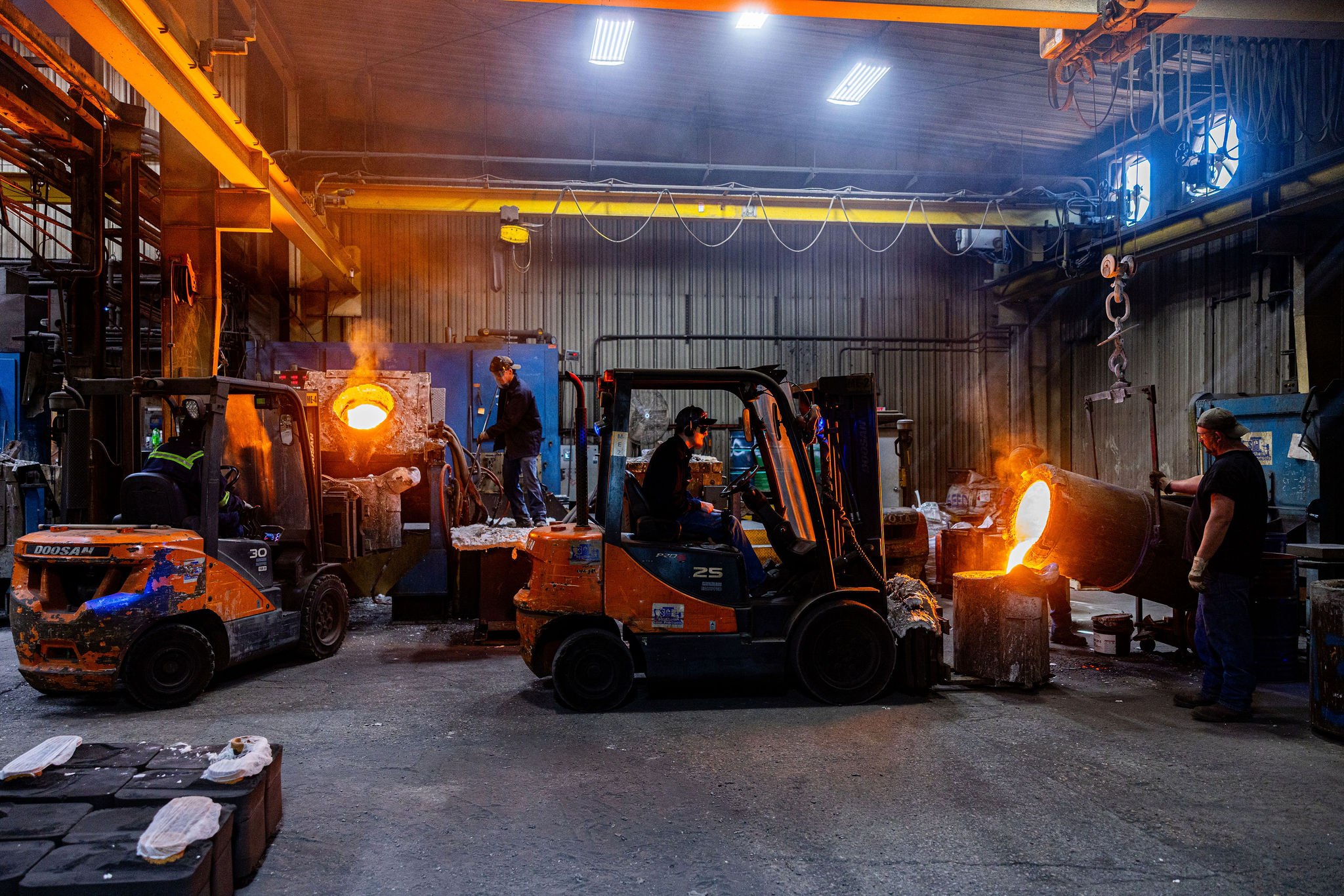
- Pour and heat treat. The alloy the drawing names, poured to the ASTM chemistry, sampled per the grade — normalize on ductile iron, stress-relieve on carbon steel, solution and temper on austenitic stainless, air-harden and temper on martensitic CA6NM / CA15, solution treat on duplex CD4MCuN. Heat-treat certification ships with the paperwork.
- Rough and finish CNC machining. Discharge flange, suction nozzle, seal-chamber bore, wear-ring register, mounting-foot pads, and any bolt patterns cut on the in-house machining centers per the drawing tolerances.
- NDE, FAI, MTR, ship. LPI per ASTM E165 or MPI per ASTM E709 on machined critical surfaces; RT per ASTM E94 on heavy shell sections if the drawing calls for it; PMI on the finished part on request; a First Article Inspection against the released drawing; an EN 10204 3.1 Material Test Report on the heat. Our inspection & QC page has the full acceptance program.
Common mistakes on inbound pump-casing drawings — engineer-to-engineer
- "Stainless" with no ASTM grade. CF8M, CA6NM, and CD4MCuN behave very differently in pump service. Name the grade.
- Hydraulic-passage tolerance carried at "as-cast." Volutes are hydraulic parts — the wall roughness and the cutwater clearance drive the head-flow curve. Give us the target Ra on the passage and the cutwater-to-impeller clearance so we can build the CAD and the mold to hit it.
- Seal-chamber bore concentricity called out from the cast surface. Concentricity has to be from the shaft-running centerline, which is a machined datum. Reference the datum, not the cast surface.
- Wear-face hardness with no measurement location. On CA6NM and CD4MCuN, "hardened stainless" is not a spec. Give us HRC, where it is measured, and the acceptance range.
- NDE class listed without an ASTM number. "LP inspect all machined surfaces" is fine, but the acceptance criteria (ASTM E165 with A609 severity level, or E446 for radiographic acceptance) belong on the drawing so we can quote against it.
- No MTR level called out. EN 10204 3.1 is our standard; 3.2 (third-party witness) moves price and lead time.
- Wear-ring register machined into the cast wall with no stock allowance. Cast the ring surface oversize; finish-machine the register concentric to the shaft centerline.
When patternless is NOT the right call for a pump volute
Five honest cut lines — we would rather route the RFQ once than take a job we should not run:
- Alloys we do not pour — A352 LC cryogenic, A297 heat-resistant Cr-Ni, Alloy 20 / Hastelloy / Inconel Ni-base, and copper-alloy bronze (B584 / B148). Specialty foundries own these; we will help route the RFQ.
- Pump volutes shipped as stamped ASME BPVC assemblies or under an API 610 monogram. The foundry pours the casting; the downstream pump-assembly vendor performs the hydro test and stamps the pump. We do not carry the U-stamp or the monogram.
- 500+ pieces per year of a stable, in-production casing indefinitely. Hard-tooled sand casting beats patternless per-piece cost at that volume — see our process-selection page for the decision framework.
- Line-down pumps that need to ship tomorrow. Patternless compresses tooling from months to days, but it does not compress heat-treat, machining, and inspection into 24 hours. Call before failure, not after.
- Hobby, decorative, or one-piece novelty work. Outside our engineering scope — see our low-volume-high-complexity page for the type of project profile we are set up to run.
What to send with an RFQ so we can quote fast
- The worn or cracked sample if you have one — or the best photos, dimensional sketches, and the mating impeller and cover if you do not.
- The pump curve, if available — sets the hydraulic acceptance datum for the rebuild.
- The drawing or the CAD if either exists — even a partial print helps.
- The ASTM alloy grade you want on the finished part (or a description of the service and we will suggest the grade).
- The seal-chamber standard the mechanical-seal vendor requires (usually ANSI B73.1 envelope).
- Quantity, timing, and whether this is a one-time replacement or a repeating MRO campaign.
- The NDE / MTR / FAI paperwork the reliability team files against.
Send the package to /contact-1 or drop it in an email — we will come back with an alloy call, a lead time, and a price. Or read the companion pages: pump-impeller replacement, discontinued pump/valve replacement, how short-run pricing works, and legacy part replication. Reference material on 3D sand-printed pump castings from the American Foundry Society foundry directory and the Steel Founders' Society of America 3D sand printing overview.
FAQ
Can you cast a replacement pump volute or casing when the OEM is gone?
Yes — reverse-engineering a worn or cracked volute or pump casing from a sample or scan is a large share of what we quote on the flow-control side. A worn casing arrives on a pallet or in a crate, we 3D-scan the external surfaces with a laser arm or structured-light scanner, capture the hydraulic passage geometry (CT through a bureau, destructive sectioning of a scrap casing, or measurement of the mating impeller and cover if scanning the interior is not practical), rebuild a parametric CAD digital twin with the worn hydraulic wall restored from unworn reference geometry, identify the parent alloy by optical-emission spectrometry, and pour the replacement to a named ASTM grade in a patternless 3D-printed sand mold. Pairs directly with our pump-impeller replacement workflow when both the rotating and stationary sides of the wet end need to be renewed together.
Which ASTM grade is right for a cast pump volute or casing?
The alloy is driven by the service — pressure, corrosion, abrasion, chloride content, and cavitation — not by the pump brand. For general municipal water, HVAC, and low-severity industrial service, ASTM A536 ductile iron in 65-45-12 or 80-55-06 is the workhorse; ASTM A48 gray iron (Class 30 or 40) still fits light-duty vibration-damping volutes. Cast carbon steel to ASTM A216 WCB / WCC handles higher pressure and temperature on general-industrial pump casings. When corrosion enters the picture, austenitic stainless per ASTM A351 CF8M / CF3M or A743 / A744 CF8M / CF3M is the standard chemical-pump alloy. For wet-abrasion service with cavitation — hydro turbine runners and volutes, dredge pump wet ends, mining slurry pump volutes — martensitic stainless to ASTM A487 or A743 CA6NM (or CA15) is the honest answer, air-hardenable to the mid-40s HRC after solution and temper. Chloride-heavy service such as coastal seawater and chloride slurry moves to duplex stainless per ASTM A890 or A995 CD4MCuN. ASTM A439 D2 austenitic ductile fills the "corrosion-plus-moderate-wear where a stainless is over-spec" gap. What we do NOT pour: cryogenic LNG carbon steel (A352 LC2/LC3), heat-resistant Cr-Ni (A297), Ni-base severe-corrosion alloys (Alloy 20, Hastelloy, Inconel), and copper-alloy bronze wet ends (B584 / B148) — those go to specialty foundries and we will route honestly.
How is the hydraulic passage recovered when the volute is worn?
The hydraulic surface of a pump volute is the one you cannot trust on a worn casing — cavitation pits, wet abrasion, and corrosion have moved the wall away from the as-designed passage. Scanning the worn passage and casting it as-scanned gives you a worn volute in fresh metal on day one, with permanently reduced hydraulic performance. The disciplined recovery uses three sources of unworn reference geometry on the sample itself: (1) unworn features on the same casting — cast draft angles on the outside, discharge-flange face, suction-nozzle geometry, bolt patterns, seal-chamber bore, cast letters and part numbers on the shoulder — carry the original as-new dimensions; (2) symmetry of the volute cutwater and tongue about the discharge centerline; and (3) the mating impeller, cover, and stuffing-box housing, which geometrically define the as-new hydraulic envelope the worn passage has to be restored back to. A deviation-analysis color map of scan-vs-restored-model is generated before the mold is committed so the reliability engineer signing the FAI can see exactly which surfaces were rebuilt and which were left in the worn state on purpose. If the sample is worn past a recoverable reference, we ask for a less-worn sibling from the site inventory or the mating impeller before we quote.
How long does a reverse-engineered pump-volute run take?
From a released CAD, 3–5 weeks to finished, machined, inspected volutes with a Material Test Report — casting simulation (heavy-section pump volutes are simulation-sensitive), 3D-printed sand mold, pour and heat treat (solution and temper on CA6NM and CD4MCuN, normalize on ductile iron, stress-relief on carbon steel), rough and finish CNC of the critical machined features (suction-nozzle face and bore, discharge-flange face and bolt pattern, seal-chamber bore, mounting-foot pad), LPI or MPI on the machined critical surfaces per ASTM E165 or E709, RT on heavy sections per ASTM E94 if the drawing calls for it, and MTR generation. Reverse-engineering from a worn sample adds 1–2 weeks up front for scan, hydraulic-passage recovery, and alloy verification by optical-emission spectrometry. Quantity range that fits patternless economics: 1 to 100 volutes per campaign; above ~500 pieces per year running indefinitely, a hard-tooled pattern shop is cheaper per piece and we will say so up front.
What paperwork ships with a cast pump volute?
Standard documentation package: Material Test Report per EN 10204 Type 3.1 with heat chemistry by optical-emission spectrometry and mechanicals from a tensile coupon poured with the heat, sampled per the ASTM grade on the drawing; visual acceptance per MSS SP-55; liquid penetrant per ASTM E165 or magnetic-particle per ASTM E709 on the machined critical surfaces; radiographic examination per ASTM E94 on heavy sections when the drawing calls for it; PMI (positive material identification) on the finished part on request; a First Article Inspection report against the released drawing; hardness readings on the wear face if a target after heat treat is specified. We do not perform the pump-assembly hydro test or apply an ASME U-stamp or an API monogram — the foundry pours the casting, the downstream pump-assembly vendor performs the pressure test and stamps the pump. Tell us the acceptance package the reliability team files against and we build the documentation to match.
When is a patternless short-run foundry NOT the right choice for a pump volute?
Five honest cut lines: (1) if the alloy required is on our do-not-pour list — cryogenic LNG A352 LC2 / LC3 volutes, heat-resistant A297 Cr-Ni, Ni-base severe-corrosion alloys (Alloy 20, Hastelloy C-276, Inconel), or a copper-alloy bronze wet end (B584 / B148); (2) if the pump volute must ship as a stamped ASME BPVC assembly or under an API 610 monogram — the foundry pours the casting, we do not carry the monogram or the U-stamp; (3) if the volume is 500+ pieces per year of a stable in-production casing indefinitely, hard-tooled sand casting beats patternless per-piece cost; (4) if the pump is down and the volute has to ship tomorrow, no foundry can compress the heat-treat-machine-inspect loop into 24 hours — call before failure, not after; and (5) hobby, decorative, or one-piece novelty work is outside our engineering scope. We would rather route the RFQ once than take a job we should not run.
Have a worn pump volute or casing? Send it over.
A sample and a drawing (or just the sample) is enough to start a quote.
Get a Quote