Industries & Impact
Short-Run Turbine and Energy Component Castings — CA6NM, A216 WCB, A536 (No Tooling, No OEM)
An independent US foundry that pours replacement hydro turbine runners, wicket gates, guide vanes, spiral casings, and stay vanes in ASTM A487 and A743 CA6NM martensitic stainless — the ASTM-recognized alloy for hydraulic components. Plus structural steam and gas turbine parts in ASTM A216 WCB/WCC carbon steel, gas engine exhaust and turbocharger housings in ASTM A439 D2 austenitic ductile or A536 100-70-03 ductile iron, and balance-of-plant valve bodies and pump volutes across the alloy list. 1 to 100 pieces per campaign, patternless (3D-printed sand mold — no permanent pattern), with reverse-engineering from a worn part or a 3D scan when the OEM is gone. Below is what we honestly pour, what we honestly do not, and the workflow that turns a worn runner or a lost drawing into a poured, machined, inspected replacement.
Who this is for
Reliability engineers and maintenance planners at hydro plants (Francis, Kaplan, Pelton, pumped-storage) with a worn cast runner, a cracked wicket gate, a corroded spiral casing, or an eroded stay ring; steam turbine and combined-cycle plant owners who need a replacement bearing housing, exhaust hood, casing, or BOP part in cast carbon or stainless steel; gas engine and compressor plant sourcing engineers with an exhaust housing or manifold in gas engine service; wind turbine OEM design engineers scoping a low-volume mainframe or bearing housing casting; and procurement teams at IPPs, utilities, and industrial plants pricing 1 to 100 piece cast replacements. Vertical #2 of the six proven-demand verticals on our story — power generation and energy — with the honest scope of what a mid-size independent sand-and-patternless foundry can and cannot pour. If your program needs a nickel superalloy hot-section blade, a superheated-steam A217 casing, or a nuclear-code stamped assembly, this is not us and we say so below.
Where our lane actually sits
Turbine and energy castings cover a wide alloy range — from cast carbon steel structural parts at the light end to nickel-based superalloys with directional-solidified microstructure at the hot end. What we pour honestly maps to hydraulic machinery and lower- to mid-temperature energy service. What we do not pour maps to the hot section of gas turbines and superheated-steam service. Framing the article this way turns each capability gap into an honest routing recommendation — a trust signal rather than a marketing claim.
Turbine and energy components we routinely pour
- Hydro turbine runners (Francis, Kaplan, Pelton) — reverse-engineered from a worn runner or a 3D scan in ASTM A487 and A743 CA6NM CL A or B martensitic stainless — the ASTM-recognized alloy for hydraulic components (cavitation and erosion resistance, weldable, quench-and-tempered).
- Wicket gates, guide vanes, stay vanes, and stay rings — CA6NM or A216 WCB/WCC per service; usually reverse-engineered from an installed set with worn trailing edges and pivot journals.
- Spiral casings, draft-tube liners, and turbine cover / head-cover castings — CA6NM, CA15, or A216 WCB per service pressure and water chemistry.
- Steam turbine and combined-cycle ancillary casings in cast carbon steel (A216 WCB/WCC) — bearing housings, exhaust hoods, structural frames, and lower-pressure casings. Not superheated main-steam A217 chrome-moly (see honest disclaim below).
- Gas engine exhaust manifolds and turbocharger housings in A439 D2 austenitic ductile iron (SiMo variants where the customer supplies the modified chemistry as an equivalent) or A536 100-70-03 high-strength ductile — reciprocating gas engines and stationary power gen sets.
- Balance-of-plant (BOP) pump volutes, valve bodies, seal chambers, and mechanical seal housings across the alloy list — the same short-run flow-control work as our pump volute, pump impeller, and ductile-iron valve body articles, applied to a power plant instead of a chemical plant.
- Wind turbine mainframes, hub segments, and bearing housing castings in A536 high-strength ductile iron — with the honest note that wind commodity volumes typically run in the hundreds to thousands per year and route to hard-tooled foundries; our 1 to 100 range fits prototype programs, aftermarket refit, and legacy fleet replacement.
- Cooling tower and hydro-plant water-handling castings — A216 WCB, A536, or A48 gray iron per service; often reverse-engineered from parts installed in the 1960s–1980s.
What we honestly do not pour
Every capability gap here is a specific, verifiable line on our metals list. Naming them turns the gap into an honest routing recommendation — and turns the article into an ICP filter that keeps the wrong-fit projects out of the queue.
- Nickel-based superalloys for gas turbine hot-section blades, vanes, and nozzles — Inconel 625/718, Hastelloy C-276, Rene 41. Not on our pour list. Route to a specialty superalloy investment-casting foundry with directional-solidification and single-crystal capability.
- Cobalt-based superalloys — Stellite grades. Not on our pour list.
- Heat-resistant Cr-Ni castings under ASTM A297 (HH, HK, HP) and A608 (HK-40 centrifugally cast tube). Not on our pour list — high-temp heat-treated Cr-Ni service; route to a specialty heat-resistant foundry.
- Chrome-molybdenum pressure-service castings under ASTM A217 — WC6, WC9, C5, C12, C12A. Not on our pour list — the alloy family for superheated main-steam-path castings. Route to a specialty pressure-casting foundry.
- Titanium alloys — compressor blades or hot-section parts. Not on our pour list.
- Cast copper alloys under ASTM B584 and B148 — aluminum-bronze, nickel-aluminum-bronze, tin-bronze marine turbine parts. We pour cast aluminum (ASTM B26 319, C355, A356) but not cast bronze.
- Directional-solidification and single-crystal microstructure — a superalloy investment-casting process, not our sand-and-patternless capability.
- ASME BPVC Section III N-stamp, ASME Section VIII U-stamp, API 610 monogram, and hydro-test stamps — those authority stamps belong on the downstream assembly vendor, not on the foundry pouring the casting.
Alloy decision by service — CA6NM, CA15, A216 WCB, A439 D2, A536
The five workhorse grades in this article map to distinct turbine and energy services. Picking the wrong grade is the single most common mistake on inbound RFQs — this section is the engineer-to-engineer version of that decision.
- A487 CA6NM CL A/B and A743 CA6NM CL A/B — martensitic stainless
- The hydro turbine alloy. Approximately 13% Cr / 4% Ni martensitic stainless with tempered martensite microstructure. Quench-and-tempered (Class A) or double-tempered (Class B). Cavitation-erosion resistance, weldability without preheat-cracking, and mechanical properties consistent across large section sizes are why the industry consolidated on this grade. Applications: runners, wicket gates, guide vanes, stay vanes, spiral casings, draft tube liners, pump wet-ends handling fresh or brackish water. Radiographic acceptance is standard on Class 1 sections.
- A487 CA15 and A743 CA15 CL A/B — 12 Cr martensitic stainless
- Lower-nickel martensitic stainless — approximately 12% Cr, minimal Ni. Comparable strength to CA6NM at lower cost, less resistance to cavitation and cold-cracking during weld repair. Common on lower-severity hydro components, some steam-turbine internal parts, and non-cavitation hydraulic machinery.
- A216 WCB and WCC — cast carbon steel
- The structural steel casting alloy. WCB (0.30% max C) and WCC (0.25% max C, tighter limits) both quench-and-normalized-or-tempered per the standard. Applications: steam turbine bearing housings, exhaust hoods, lower-pressure casings, gas engine structural parts, BOP valve bodies below 400°F service, cooling tower and hydro-plant structural castings. Not for superheated main-steam service — that is A217 chrome-moly territory.
- A439 D2 — austenitic ductile iron (Ni-Resist Type D2)
- Austenitic ductile iron with nickel and chromium in the matrix — thermal-cycling, corrosion, and moderate-heat service. Applications: gas engine exhaust manifolds and turbocharger housings on stationary power gen sets, thermal-cycling parts on reciprocating engines, water pump wet ends handling brackish or elevated-temperature water. Not for superheated-steam or hot-section gas turbine service.
- A536 100-70-03 and 80-55-06 — high-strength ductile iron
- Normalized-and-tempered pearlitic ductile iron. Higher-strength grades used for wind turbine mainframes, hub segments, bearing housings, gearbox housings on large stationary machines, structural mounts, and any casting where cast iron mechanical properties need to lift into the low-alloy steel range without the metallurgical complexity of cast steel.
- A48 gray iron and A278 gray iron — vibration damping
- Where the design intent is vibration damping, thermal conductivity, and machinability — not tensile strength. Applications: some steam turbine covers and inspection housings, gas engine cylinder blocks and heads on legacy repowering programs, and structural or ornamental hydraulic-machinery castings.
Patternless workflow for a turbine or energy replacement casting
The workflow below runs door-to-door — from RFQ intake to a poured, machined, and inspected casting on your dock. Every step maps to a specific engineering artifact (a CAD digital twin, a simulation report, a printed sand mold, an MTR, an NDE report, an FAI) that the downstream reliability team files against the asset. See the lead-times article for the four honest planning bands and the shortening levers.
- RFQ intake and drawing / sample / scan review. Alloy pinned against our metals list, service conditions confirmed (working fluid, pressure, temperature, cavitation exposure, water chemistry), acceptance criteria drafted (NDE class, radiography, MTR level, hydro test if any, FAI or PPAP if required). If a drawing exists, no reverse-engineering. If a physical sample is on hand, we scan it in-house on a FARO or Creaform arm; see our scan file requirements article for what to send if you scan first.
- Reverse-engineering (RE) and CAD digital twin. On a worn runner, wicket gate, or spiral casing, we do NOT reproduce the worn geometry. We recover the as-new hydraulic passage from unworn reference features — bosses, mating flanges, bolt patterns, machined seal-water registers, and symmetric geometry on the runner band. We validate the recovery against the mating stationary parts. Full workflow in the reverse-engineering article.
- Solidification and filling simulation. A MAGMASOFT or equivalent simulation on the CAD twin — heavy-section runners and spiral casings have long solidification and non-trivial feeder placement. See our simulation article. The output is a signed-off gating and feeding plan before any mold is printed.
- 3D-printed sand mold. The signed-off CAD is sent to a Voxeljet or ExOne binder-jetted sand printer (see our 3D sand printing capability). No permanent pattern is built — the mold prints in days rather than weeks. Cope, drag, and cores print as a set.
- Melt, pour, shakeout. The alloy is melted to the ASTM chemistry range (verified by OES coupon), poured into the printed sand mold, and shaken out. On CA6NM, a fast quench-and-cool sequence is respected because the martensitic transformation is temperature-critical.
- Alloy-specific heat treat. CA6NM: austenitize + quench + double-temper per A487/A743 (3–7 days). CA15: austenitize + quench + temper. A216 WCB/WCC: normalize + temper or Class-appropriate treatment. A439 D2: no additional heat treat beyond the melt-side austenitizing. A536 higher grades: normalize + temper. Skipping heat treat means the casting is not the grade on the MTR.
- CNC machining. Critical features — bores, sealing faces, bolt patterns, hydraulic-passage exits, and machined seal-water registers — machined to print on our CNC (see CNC machining). Cast-only surfaces are left as-cast to ISO 8062-3 DCTG 10–12 tolerance.
- NDE, FAI, PMI, and documentation. Liquid-penetrant (LPI, ASTM E165) or magnetic-particle (MPI, ASTM E709) on machined surfaces, radiography (RT, ASTM E94) on Class 1 sections, ultrasonic (UT, ASTM A609) on heavy-section castings, dimensional FAI against the CAD twin, PMI on request, and the EN 10204 3.1 material test report. See our inspection and QC page. Package ships with the part.
Critical machined features and tolerances
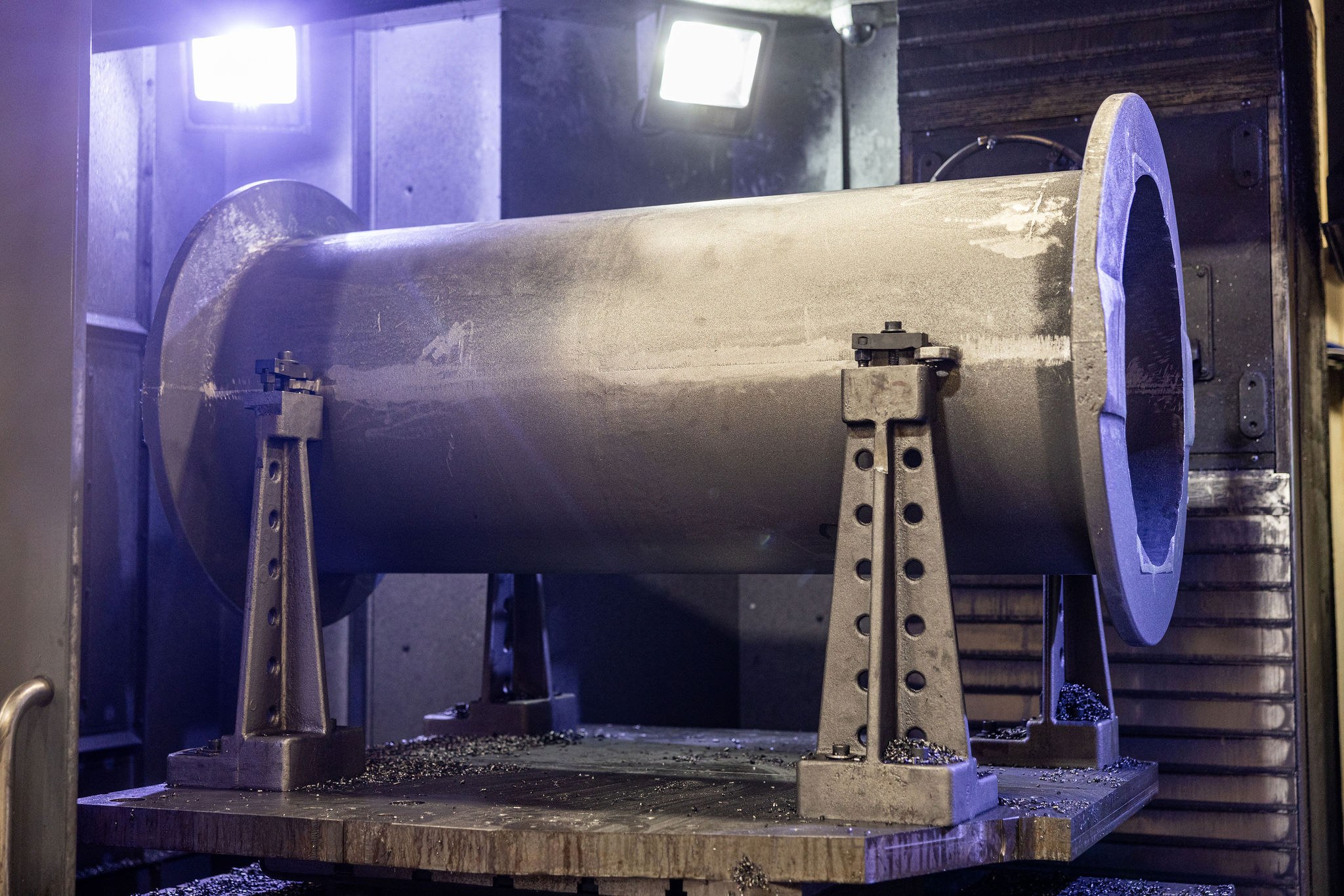
Turbine and energy castings are near-net-shape as-poured and hit their final tolerances on the CNC. The features below are the ones that a hydro or steam plant reliability engineer will actually check on acceptance:
- Runner and impeller bores — shaft-fit bore, keyway (on older machines), and the mating hub register. Machined against the CAD twin, not the worn part.
- Sealing faces — flange mating faces, gasket lands, and O-ring grooves on covers, exhaust hoods, and BOP valves. Ra finish and flatness per the drawing or ANSI B16.5 where applicable.
- Bolt patterns — machined against the mating machine part, not the worn casting. A worn casting is a wear witness, not a datum.
- Hydraulic-passage exits — the entry and exit of the runner and wicket gate hydraulic passages, the trailing edges of guide and stay vanes. These are cast to near-net-shape and finish-machined only where the drawing calls it out.
- Machined seal-water registers — on runners with mechanical seal or labyrinth seal interfaces, the register is a critical fit feature and often the best unworn reference on the part.
General cast-surface tolerance: ISO 8062-3 DCTG 10–12 for patternless sand casting, tightening to DCTG 8–10 on rigid geometries. Machined-feature tolerances per the drawing, typically within ±0.001–0.005 in on critical bores and sealing faces.
Documentation package a utility, IPP, or plant will actually accept
- EN 10204 3.1 material test report — chemistry (OES) and mechanical properties from the actual heat, signed against the ASTM grade.
- Dimensional first-article inspection (FAI) — critical hydraulic-passage checks against the CAD digital twin, machined-feature dimensional inspection.
- MSS-SP-55 visual acceptance — cast-surface defect acceptance per the recognized standard.
- LPI (ASTM E165) or MPI (ASTM E709) — NDE on all machined surfaces; MPI applies to ferrous non-austenitic (CA6NM and CA15 are ferrite/martensite, so MPI applies; austenitic stainless — CF8M/CF3M — is non-magnetic, so LPI is used).
- RT (ASTM E94) — radiographic acceptance on Class 1 pressure or safety-related sections. Levels 1–4 as called out.
- UT (ASTM A609) — ultrasonic acceptance on heavy-section castings; often paired with RT.
- PMI (positive material identification) — spectroscopic verification on the finished casting, on request.
- Cast weld repair record — where an ASTM-permitted repair weld is required, the weld record is filed against the drawing.
- Assembly-side stamps — ASME III, ASME U-stamp, API 610, and hydro-test stamps are held by the downstream assembly vendor. We deliver the foundry-side traceable-MTR package.
Common mistakes on inbound turbine and energy drawings
- Specifying "stainless steel" without a cast grade. Wrought 316 (UNS S31600) is not the same as cast CF8M (UNS J92900) or cast CA6NM (UNS J91540). The foundry pours to a cast grade; the wrought grade is a mill product. Spec the ASTM grade and the class.
- Copying an OEM drawing that calls for A217 WC6 or A217 C12. A217 chrome-moly is not on our pour list. On a superheated-steam A217 casing, we route you to a specialty pressure-casting foundry. On a lower-temperature part where A216 WCB is functionally sufficient, we can requalify — but the drawing revision needs to be signed off on the customer's side.
- Assuming CA6NM and CA15 are interchangeable. CA6NM (13Cr/4Ni) and CA15 (12Cr) have different mechanical property envelopes, different weld response, and different price points. Cavitation-exposed hydraulic components are CA6NM; general-service martensitic stainless castings can be CA15.
- Skipping the radiographic acceptance level. A drawing that says "RT required" without a level (1, 2, 3, or 4) is unquotable — the level drives the cost and the rejection rate. Same for LPI acceptance level.
- Scanning a worn runner and expecting the casting to reproduce the scan. The worn part is a witness of degradation, not a specification. Recovery of the as-new hydraulic passage is on us; the drawing revision and the CAD sign-off are on the customer.
- Asking for an ASME III or U-stamp on the foundry line. Those stamps belong on the assembly vendor. The foundry-side deliverable is a traceable MTR-anchored casting.
- Confusing "no minimum order" with "one casting for a hobby." The 1 to 100 piece per campaign range is engineering-grade replacement work with a real ASTM grade, a real NDE class, and a real acceptance package. It is not a decorative one-off.
What to send in the RFQ to get a real quote back
- The ASTM grade and class (or the service conditions that let us specify one — working fluid, pressure, temperature, cavitation exposure, water chemistry).
- A drawing, 3D model, physical sample, or scan file — any age is fine. See our scan file requirements article if you are scanning first.
- The quantity — the normal short-run range is 1 to 100 pieces per campaign.
- The target lead time and hard deadline.
- The NDE class and the radiographic acceptance level if RT is required.
- The machining scope — critical features, sealing faces, bolt patterns, and machined register tolerances.
- The documentation package — MTR level, FAI/PPAP, PMI on request, and assembly-side stamps (if any) held by the downstream vendor.
- The mating machine part, if available — bolt-hole spacing, seal-chamber standard, and hydraulic-passage envelope validation are best against the mating part, not the worn casting.
Sources and further reading
- ASTM A487/A487M — Standard Specification for Steel Castings Suitable for Pressure Service (CA6NM, CA15).
- ASTM A743/A743M — Standard Specification for Castings, Iron-Chromium, Iron-Chromium-Nickel, Corrosion Resistant, for General Application (CA6NM, CA15, CF3M, CF8M).
- ASTM A216/A216M — Standard Specification for Steel Castings, Carbon, Suitable for Fusion Welding, for High-Temperature Service (WCA, WCB, WCC).
- ASTM A439/A439M — Standard Specification for Austenitic Ductile Iron Castings (D2 Ni-Resist).
- ASTM A536 — Standard Specification for Ductile Iron Castings.
- ASTM A48/A48M — Standard Specification for Gray Iron Castings.
- ASTM A217/A217M — Standard Specification for Steel Castings, Martensitic Stainless and Alloy, for Pressure-Containing Parts, Suitable for High-Temperature Service (not on our pour list — cited for the honest disclaim).
- ASTM A297/A297M — Standard Specification for Steel Castings, Iron-Chromium and Iron-Chromium-Nickel, Heat Resistant, for General Application (HK-40, HP — not on our pour list — cited for the honest disclaim).
- ASTM E165 — Standard Practice for Liquid Penetrant Testing.
- ASTM E709 — Standard Guide for Magnetic Particle Testing.
- ASTM E94 — Standard Guide for Radiographic Examination.
- ASTM A609 — Standard Practice for Castings, Carbon, Low-Alloy, and Martensitic Stainless Steel, Ultrasonic Examination Thereof.
- Steel Founders' Society of America (SFSA) — patternless / 3D-printed sand mold industry material, lead-time and volume crossover data.
- American Foundry Society (AFS) — foundry industry references and directory.
- Ductile Iron Society — A536 and A439 property references.
Related reading on this site
- CA6NM vs CA15 — when to spec which — the martensitic stainless call-out that sits under this vertical.
- Broken or cracked cast part — replacement from a sample or scan — when the energy part arrives in pieces.
- Pump Volute Casing Replacement Cast from Sample or Scan — the BOP pump wet-end companion.
- Pump Impeller Replacement Cast from a Worn Sample — CA6NM pump wet-end companion.
- Low-Volume CF8M Stainless Casting Supplier — the austenitic-stainless procurement companion (different microstructure than CA6NM).
- Lead Times for a Replacement Casting When a Line Is Down — the four honest planning bands.
- Reverse-Engineering a Worn Casting from a Sample or 3D Scan — the RE pillar.
- From 3D Scan to Cast Part: What Your Scan File Needs to Contain — the mesh and unit specification for a usable scan.
- Heavy-Equipment Wear-Part Castings — Reverse-Engineered Replacements — the wear-part companion (CA6NM, duplex, A536).
- Made-in-USA Domestic-Melt Replacement Castings for Obsolete Parts — the domestic-melt scope statement.
Capability pages
- Metals poured — the definitive alloy list.
- Legacy part replication — the obsolete-parts pillar.
- Low-volume, high-complexity metal castings — the short-run pillar.
- 3D sand printing (patternless casting) — the mold-print capability.
- Engineering and DfM — CAD, simulation, gating.
- CNC machining — finish machining after pour.
- Inspection and QC — NDE, FAI, MTR.
FAQ
Which turbine and energy components can you actually pour as a short-run replacement?
The parts our alloy list supports honestly: hydro turbine runners, wicket gates, guide vanes, stay vanes, spiral casings, and draft-tube liners in ASTM A487/A743 CA6NM martensitic stainless (the ASTM-recognized alloy for hydraulic components); steam and gas turbine bearing housings, exhaust hoods, structural casings, and BOP (balance-of-plant) pump volutes and valve bodies in ASTM A216 WCB/WCC carbon steel; gas engine exhaust manifolds, turbocharger housings, and thermal-cycling parts in A439 D2 austenitic ductile iron or A536 100-70-03 high-strength ductile; and wind turbine mainframe, hub, and bearing housing castings in A536 high-strength ductile iron — with the honest note that wind commodity volumes usually exceed our per-job 1–100 range and route to hard-tooled foundries. Anything hotter than what these grades can serve (superheated main steam paths, gas turbine hot-section blades and vanes, exotic nickel superalloy service) is not us — we say so clearly below and route those to the right specialty shop.
Do you pour Inconel, Hastelloy, or other nickel-based superalloys for gas turbine hot-section parts?
No. Our /metals-poured list is gray iron (A48, A278, A436 N1B), ductile iron (A536 in all four common grades and A439 D2), carbon and low-alloy steel (A216 WCA/WCB/WCC, A352 LCB), stainless (A351 CF3M/CF8M, A487 CA6NM/CA15, A743 CA6NM/CA15/CF3M/CF8M, A744 CF3M/CF8M), duplex stainless (A890 and A995 CD4MCuN), and aluminum (B26 319, C355, A356). Nickel-based superalloys (Inconel 625/718, Hastelloy C-276, Rene 41), cobalt-based superalloys (Stellite), heat-resistant Cr-Ni austenitic castings under ASTM A297 or A608 (HK-40, HP grades), chrome-molybdenum steels under ASTM A217 (WC6, C12), titanium alloys, and cast copper alloys under ASTM B584 or B148 are not on our pour list. For gas turbine hot-section castings — blades, vanes, nozzles — you want a specialty superalloy foundry with directional-solidification and single-crystal capability. Turning those capability gaps into honest routing keeps the wrong-fit projects out of the queue and the right-fit projects in.
Can you cast hydro turbine parts from a worn runner or a 3D scan when there are no OEM drawings?
Yes, and this is a large share of what a short-run patternless foundry does for hydro-plant MRO. When a runner, wicket gate, guide vane, or spiral casing has been in service for decades and the OEM is gone or the drawings are lost, we reverse-engineer from the worn part or a 3D scan. The critical work is recovering the as-new hydraulic-passage geometry from a worn part — you do not want the new casting to reproduce the wear. We anchor the recovery on unworn reference features (unworn bosses, mating flanges, bolt patterns, and the machined seal-water register on the runner band) and validate against the mating stationary parts on the machine. See our reverse-engineering workflow article and our scan-file requirements article for the mesh, coordinate, and unit specification that makes the recovery clean. The CA6NM heat treat, radiographic acceptance, and the mating-fit validation happen after the CAD digital twin is signed off — not before.
What is a realistic lead time on a cast turbine or energy replacement part with no existing tooling?
Four honest planning bands, matched to our lead-times article and consistent with SFSA published ranges for patternless sand casting. Existing pattern + standard alloy: 2–4 weeks. New patternless (3D-printed sand) mold, standard alloy (A216 WCB, A536 ductile, A48 gray iron), drawings in hand: 4–8 weeks. Reverse-engineered from a worn sample or a 3D scan, martensitic stainless (CA6NM/CA15) with quench-and-temper and radiographic acceptance: 8–16 weeks. Large heavy-section runners or spiral casings with a full FAI, PPAP, and PMI documentation package and Class 1 radiography: 12–24+ weeks. Alloy-specific heat treat adds 3–7 days for CA6NM (austenitize/quench/double-temper per ASTM A487) and 3–5 days for the higher A536 ductile grades (normalize-and-temper). Skipping the heat treat means the casting is not the grade on the MTR, which means the utility or plant owner has no evidence to accept it against the asset. There is no honest "24-hour" turbine casting.
How do you handle the acceptance package a utility, IPP, or plant owner will require for a turbine casting?
Standard package for a cast turbine component: EN 10204 3.1 material test report for chemistry and mechanical properties from the actual heat, dimensional first-article inspection (FAI) with critical hydraulic-passage checks against the CAD digital twin, MSS-SP-55 visual acceptance for surface defects, liquid-penetrant (LPI, per ASTM E165) or magnetic-particle (MPI, per ASTM E709) NDE on all machined surfaces, radiographic examination (RT, per ASTM E94) on Class 1 pressure-containing sections, ultrasonic examination (UT, per ASTM A609) on heavy-section castings, and positive material identification (PMI) on request. What we deliberately do NOT hold: an ASME BPVC Section III nuclear stamp, an ASME BPVC Section VIII U-stamp for pressure vessels, an ASME III N-stamp, an API 610 monogram, or any hydro-test authority stamp. Those stamps belong on the downstream assembly vendor, not on the foundry pouring the casting. If your acceptance path requires a stamped assembly, we pour to the assembly vendor and they stamp downstream — the traceable, MTR-anchored path.
When is a short-run patternless US foundry NOT the right fit for a turbine or energy project?
Five honest ways this is not us. First, gas turbine hot-section blades, vanes, and nozzles in nickel-based or cobalt-based superalloy with directional solidification or single-crystal microstructure — that is a specialty superalloy investment-casting foundry, not us. Second, superheated main steam service in ASTM A217 chrome-moly (WC6, C12, C12A) — that grade is not on our pour list; route to a specialty pressure-casting foundry. Third, 500+ pieces per year running indefinitely, year over year — beyond that industry-published crossover, a hard-tooled pattern is cheaper per piece than patternless (see SFSA). Fourth, an assembly that must ship with an ASME U-stamp, an ASME III N-stamp, an API 610 monogram, or a nuclear-code stamp on the foundry line — the stamp belongs on the assembly vendor. Fifth, line-down replacement that ships tomorrow — the temporary repair (weld build-up, bearing set, gasket) goes in while the new casting is being poured in parallel. Turning each of these five gaps into an honest disclaim keeps the queue focused on the projects we actually do best: 1 to 100 piece cast replacements of hydro turbine components, structural steam and gas turbine parts, gas engine exhaust housings, and BOP castings, with or without drawings, made in the USA.
Have a worn runner, a lost drawing, or a legacy turbine part? Send it over.
Send the ASTM grade (or the service conditions), a drawing or a scan or a physical sample, the quantity, the deadline, and the NDE class. A real quote comes back with a real schedule.
Get a Quote