
Industries & Impact
Waterworks & Municipal Water / Wastewater: Short-Run Cast Pump & Valve Parts
Sourcing a short run of cast replacement pump, valve, or hydrant parts for a municipal water or wastewater system? The realistic answer from an independent US patternless foundry is 1 to 100 pieces, no minimum order, 4 to 7 weeks end-to-end, poured in A536 ductile iron, A216 WCB cast carbon steel, A351 / A743 CF8M austenitic stainless, or A890 / A995 CD4MCuN duplex to the drawing — with a 3.1 MTR, FAI dimensional, LPI or MPI, and PMI on delivery. We pour the base casting. NSF/ANSI 61 potable-water listings and AWWA C509 / C515 / C550 assembly listings are held downstream by your certified coater and by the valve, hydrant, or pump OEM — we route the work correctly on RFQ day, and we do not claim listings we do not hold.
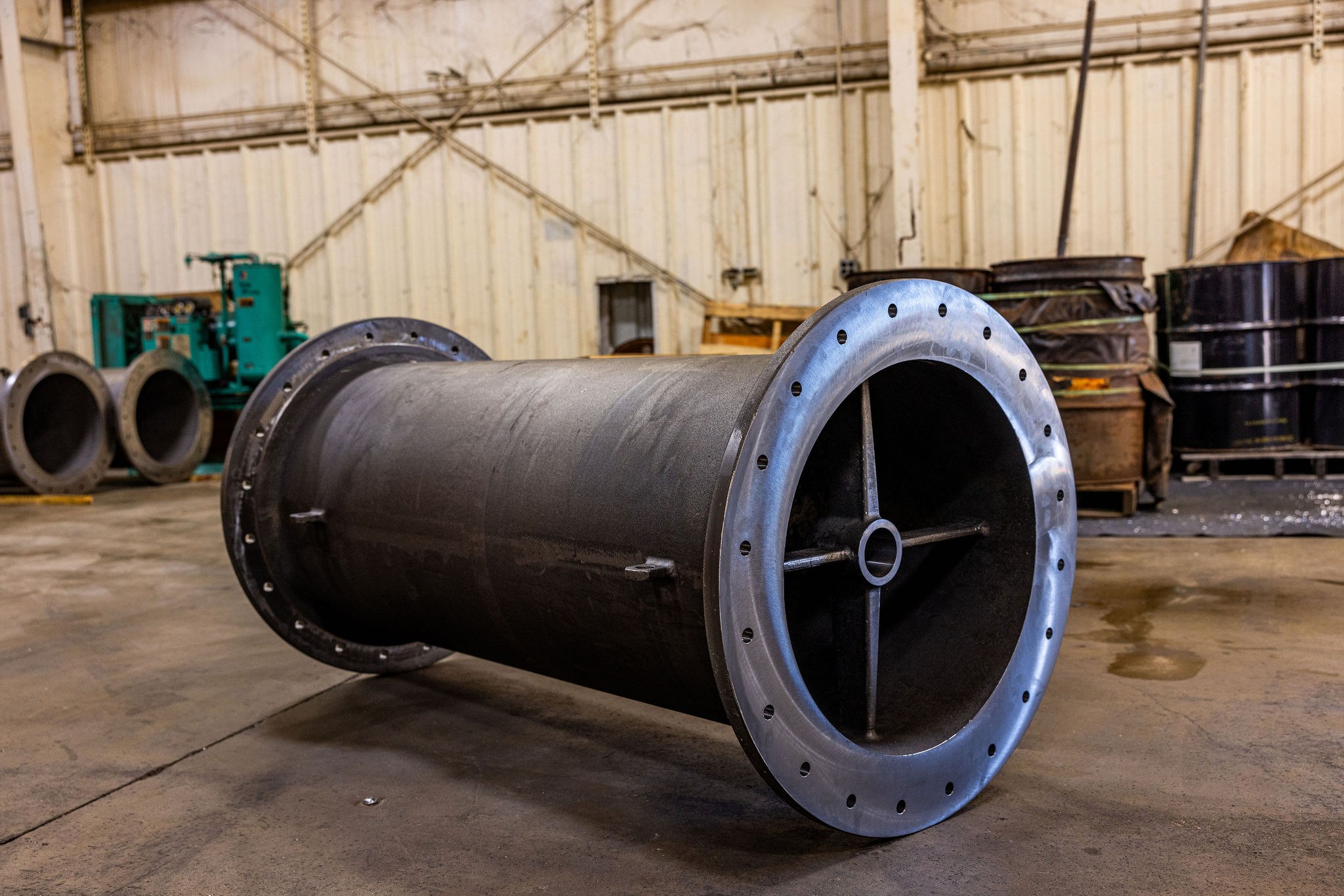
Who this is for
This page is written for reliability and maintenance engineers at municipal water and wastewater utilities, for MRO buyers and sourcing engineers at water and wastewater equipment OEMs (pump, valve, hydrant, fitting), and for design engineers writing a cast replacement into a short-run drawing package. It is for the buyer who has run into the same wall everyone else does: the OEM is gone or the model is obsolete, the pattern is scrapped, the aftermarket distributor only sells assemblies, and the surviving foundries want a multi-thousand-piece annual commitment before they will pour a single body. If your realistic quantity is 1 through around 100 pieces, if you need a legitimate cast body in A536, A216 WCB, CF8M, or CD4MCuN tied to a real 3.1 MTR, and if you need finish-machining plus NDE in one place, the rest of this page is what to expect.
What "waterworks" means for a cast part
"Waterworks" is a catch-all for the cast pump, valve, hydrant, and fitting parts running in municipal water treatment and distribution and in wastewater collection and treatment. From a metallurgy point of view, the service breaks into a handful of buckets:
- Potable-water distribution — treated drinking water in mains, service lines, hydrants, valves, and fittings. Corrosion driver is mild; the big engineering constraint is downstream NSF/ANSI 61 listing on wetted components.
- Raw and surface-water intake — untreated river, reservoir, or lake water carrying grit, silt, and biological load. Wet-abrasion becomes the driver on pump wet-ends.
- Wastewater collection and lift-station service — sanitary sewage carrying grit, rag, and biological load. Wet-abrasion plus sulfide corrosion (H₂S). Cast iron bodies dominate; wet-end wear parts move up-alloy.
- Chloride-heavy process — brackish groundwater, coastal utility intake, sodium-hypochlorite dosing, ferric-chloride dosing, chlor-alkali service. Chloride pitting drives stainless (CF8M or CF3M) and, on the severest service, cast duplex (CD4MCuN).
- Sludge, digested-solids, and biosolids handling — wet abrasion on pump wet-ends and valve trims, plus chemistry that varies with the utility.
The right alloy call-out lands on the service, not the label. The next section walks through the decision.
Alloy decision by service
The single most useful thing this page can do is help you land on the right cast alloy before the RFQ goes out. All grades named below are on our metals-poured list.
- ASTM A536 ductile iron — the default body for potable-distribution valve bodies, hydrant shoes and barrels, tapping-sleeve castings, mechanical-joint gland castings, and pump casings on clean water. We pour 60-40-18, 65-45-12, 80-55-06, and 100-70-03 — pick the grade on strength and elongation, not habit. Directly aligned with buyer-side standards (see AWWA C509 resilient-seated gate valves and AWWA C515 reduced-wall RSGV, which reference ductile-iron bodies).
- ASTM A48 and A278 gray iron — non-pressure body work: valve covers, gearcase covers, sight glasses, light-duty grates. Gray iron has excellent damping and machinability but low elongation; do not spec it into a pressure body.
- ASTM A439 D2 austenitic ductile iron — used where corrosion resistance above gray iron is needed but stainless is overkill. Common on wet abrasion with mild corrosion.
- ASTM A216 cast carbon steel — WCA, WCB, WCC — the default body for pressure-service valve castings above ductile-iron pressure class, and for pump volutes in clean-water pressure service. WCB is the workhorse.
- ASTM A352 LCB cast low-temperature carbon steel — cold-service piping and pump-and-valve bodies where the working temperature runs below ambient carbon-steel's Charpy floor. Common on above-ground raw-water intake in cold climates.
- ASTM A351 CF8M / CF3M and ASTM A743 CF8M / CF3M / CA6NM / CA15 and ASTM A744 CF8M / CF3M — cast 316 and 316L for potable and process service where cast iron does not carry the corrosion load. Also the workhorse alloy for chloride-dosing manifolds, sodium-hypochlorite pumps, and ferric-chloride wet-ends. Martensitic CA6NM sits alongside for high-strength pump wet-ends on abrasive service. See low-volume CF8M stainless — what to expect.
- ASTM A890 and A995 CD4MCuN duplex — brackish groundwater, high-chloride potable service, chloride-heavy dosing, and wet-abrasion on chloride pump wet-ends. Roughly twice the yield strength of cast 316 and materially better pitting resistance (PREN in the 30 to 35 range). See low-volume duplex CD4MCuN casting supplier — no minimum.
- ASTM A487 CA6NM (Class A or B) and CA15 (Class A or B) — heat-treated martensitic pressure work; pump wet-ends and turbine-adjacent components on severe wear-and-corrosion service.
What our waterworks work actually IS
Positive positioning is faster than a long list of negatives. We are an independent US foundry, not the aftermarket arm of a pump, valve, or hydrant OEM. We pour the base casting — a valve body, a hydrant shoe, a pump volute, an impeller — in A48, A536 (all four grades in scope), A216 WCB, A351 or A743 CF8M / CF3M / CA6NM / CA15, A744 CF8M / CF3M, A487 CA6NM / CA15, A890 or A995 CD4MCuN, or A439 D2 austenitic ductile at the 1 to 100 piece scale on our patternless workflow. The final NSF/ANSI 61 potable listing, the AWWA C509 / C515 / C550 assembly listing, the hydro test on the assembled valve or hydrant, the ASME U-stamp, and the API 610 monogram are held by downstream vendors on the assembled and tested product — we do not claim them, and we route the work to the right vendor on RFQ day. That is the shape of the shop; the rest of this page is how it runs.
The patternless workflow for a 1–100 piece waterworks casting
- Days 1–3. CAD review — or 3D-scan and digital-twin rebuild if you only have a worn sample of an obsolete hydrant, valve body, or pump volute. DFM feedback on draft, parting, machining stock, hot spots, shrink risk, and heavy-section feeding. Alloy call-out confirmed against the service (see the decision section above). See reverse-engineering a worn casting and what your 3D scan file needs to contain.
- Days 3–7. Solidification simulation in MAGMA / NovaCast. Locate shrink and hot spots on heavy-section valve bodies and pump volutes before metal moves.
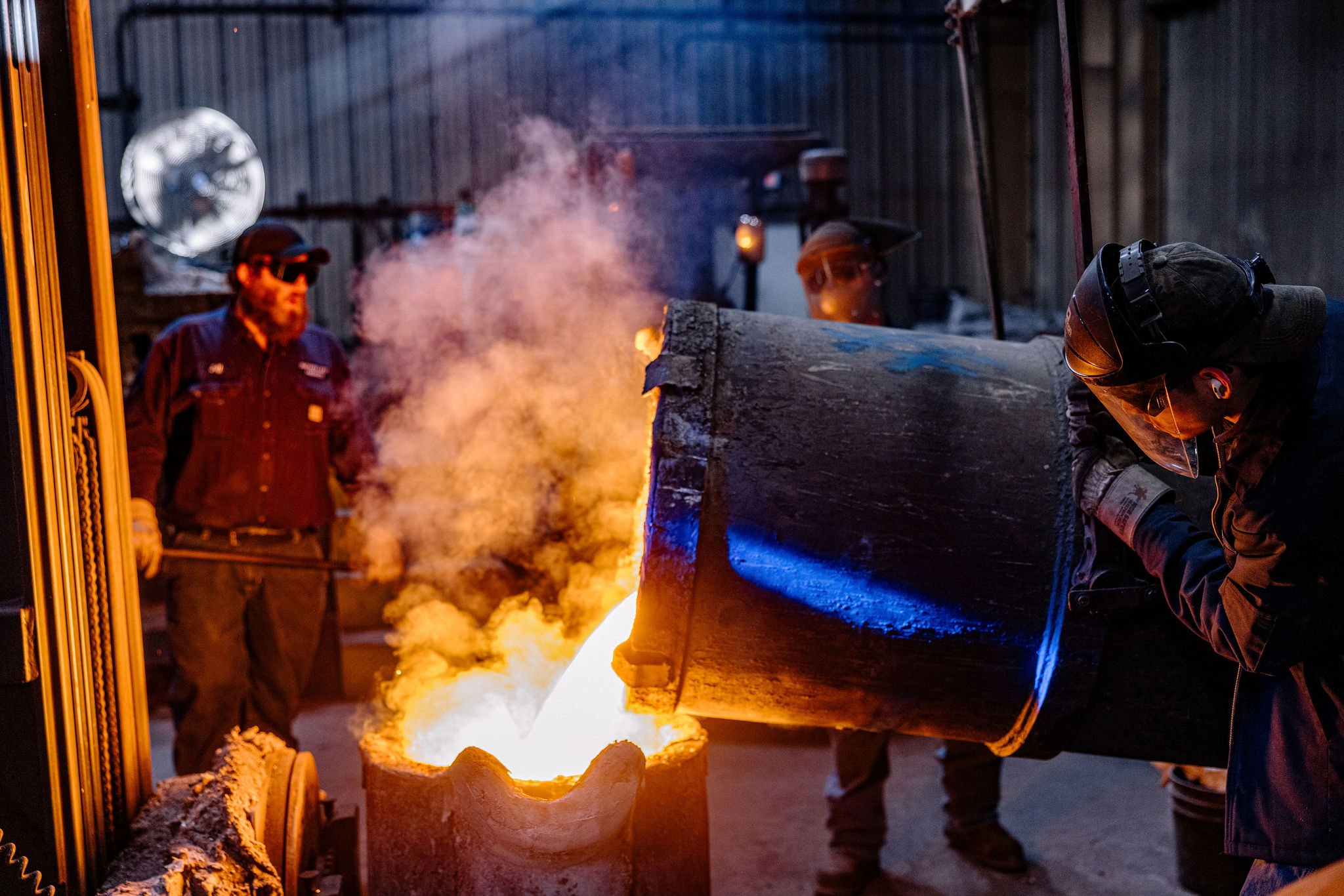
- Days 7–18. 3D-printed sand mold built and dressed on our printer. Melt to the ordered ASTM grade, poured, shaken out, cleaned. The underlying binder-jet workflow is documented by the Steel Founders' Society of America.
- Days 18–24. Heat-treat to the grade — ductile-iron anneal or normalize per A536, normalize-and-temper on cast carbon steel per A216, solution anneal and rapid water quench on stainless and duplex per A351 / A743 / A744 / A890 / A995. Furnace chart recorded and certified.
- Days 24–33. CNC machining of flange faces, bolt patterns, seat and gate registers, seal-water registers, hydrant valve stems, and pump wear-ring registers to print on our in-house equipment. See CNC machining.
- Days 33–40. NDE per spec — LPI per ASTM E165, MPI per ASTM E709, RT per ASTM E94, UT per ASTM A609 as the spec requires — FAI dimensional, PMI, MTR issued per EN 10204 3.1, final visual per MSS-SP-55, pack and ship.
Ductile-iron and cast carbon-steel jobs typically land at the shorter end of the 4-to-7-week band; CF8M mid-band; CD4MCuN a shade longer for the solution-anneal-and-quench discipline. We quote a real schedule per job — see lead times for a replacement casting when a line is down.
Critical machined features on a waterworks casting
Cast surfaces run to ISO 8062-3 DCTG grade 10–12; every feature that mates or seals is machined to print. On waterworks bodies that means:
- Flange faces per ANSI B16.1 (gray iron), ANSI B16.42 (ductile iron), or ANSI B16.5 (steel) — flatness, finish, bolt pattern, and raised- or flat-face profile.
- Gate and seat registers on valve bodies — bore diameter, seat-ring counterbore, seat gasket seal face, stuffing-box or bonnet register.
- Bonnet / body joint — sealing face, bolt-hole pattern, register step.
- Hydrant valve stems, valve seats, and shoe-flange registers.
- Pump wear-ring registers and seal-chamber IDs on pump volutes — the wet-end tolerances that make the difference between a good pump and a leaking one.
- Mechanical-joint gland pockets, tapping-sleeve seats, and coupling registers on fitting castings.
Reverse-engineering a walked-away hydrant, valve body, or pump volute
The majority of our waterworks MRO work is reverse-engineered — an obsolete hydrant model with the OEM gone, a discontinued pump family, a 1970s valve body a utility is still running. The path:
- Ship the worn sample (or two — one reference, one to strip and measure).
- We 3D-scan the exterior and any accessible interior geometry (see from broken part to digital blueprint).
- We rebuild the digital-twin CAD, correcting for wear, corrosion allowance, and design intent.
- Solidification simulation, then 3D-printed sand mold direct from CAD.
- Pour, heat-treat, machine, and NDE to your drawing — hand back both the manufacturable model and the physical part in your alloy and finish.
There is no pattern to build and none to store. The same discipline is documented for the pump-wet-end side of the work on pump impeller replacement from a worn sample and pump volute and casing replacement from sample or scan. For the discontinued-OEM story specifically, see replacing a discontinued pump or valve casting when the OEM is gone.
The documentation package you should expect
"Low volume" is not "low documentation." A short-run waterworks casting ships with a real engineering paper trail:
- MTR (Material Test Report)
- Chemistry and mechanical properties for the heat per EN 10204 3.1, tied to the ordered ASTM grade (A536, A216 WCB, A351 CF8M, A890 CD4MCuN, etc.).
- Heat-treat record
- Furnace chart and certification confirming the applicable cycle — ductile-iron anneal or normalize, cast-carbon-steel normalize-and-temper, or stainless / duplex solution anneal with rapid water quench.
- FAI (First Article Inspection)
- Dimensional verification against the released print for the first piece of the lot, in a format compatible with PPAP-style production-approval workflows.
- NDE reports
- Visual per MSS-SP-55, LPI per ASTM E165, MPI per ASTM E709, RT per ASTM E94, UT per ASTM A609 as the spec requires. LPI is the cleaner default on cast duplex CD4MCuN because MPI reads inconsistently across the roughly 50/50 ferrite / austenite phase mix.
- PMI record
- Handheld XRF or benchtop OES confirming grade identity. Common on chloride- and chlorine-service work.
- Ferrite % on request (duplex only)
- Point count per ASTM E562 on a prepared metallographic sample. Specify the acceptance band on the drawing if service depends on phase balance.
NDE and dimensional inspection are performed in-house. See inspection & QC for the equipment list. Ductile-iron microstructure and mechanical-property references are documented by the Ductile Iron Society and the American Foundry Society.
Common mistakes on inbound waterworks drawings
Speaking engineer-to-engineer, the recurring mis-specs we see on RFQs for cast waterworks parts:
- "NSF/ANSI 61 by the foundry." The listing is held on the certified drinking-water system component (usually the coated body or the assembled hydrant), not on the bare casting. Route the coating and listing to a certified downstream vendor.
- "AWWA-listed by the foundry." AWWA C509 / C515 / C550 are held by the valve or hydrant OEM on the assembled and tested product. The foundry pours the body.
- "Ductile iron" with no ASTM grade. 60-40-18, 65-45-12, 80-55-06, and 100-70-03 are not interchangeable on strength and elongation. Spec the grade — e.g., "ASTM A536 65-45-12."
- "Stainless steel" with no cast grade. Cast 316 is CF8M under A351 or A743 or A744, not "316 casting." Wrought 316 (UNS S31600) is a service-center product, not a casting. Spec the ASTM number and grade.
- "2205 casting." 2205 is the wrought designation. The cast duplex equivalent is CD4MCuN under A890 or A995 — re-spec it that way.
- Cast bronze internals called out on the foundry line. Bronze and aluminum-bronze potable internals (B584, B148) go to a copper-alloy foundry — we pour aluminum (B26), not bronze.
- Missing hydro-test scope. Foundry pours the casting; hydro test on the assembled valve or hydrant per the governing standard (see ASME B16.34 where applicable) is a downstream vendor's scope. Point it at the right vendor.
When a short-run patternless foundry is NOT the right fit
Same discipline as every article we write — better an honest "not us" than a slow bad-fit quote:
- NSF/ANSI 61 potable-water listing on the finished casting itself. The listing is held on the coated body or the assembled component. Foundry pours; certified coater and the valve or hydrant assembler carry the listing.
- AWWA C509 / C515 / C550 listing on the assembled valve or hydrant. Held by the valve or hydrant OEM on the assembled, tested, listed product. Foundry pours the body.
- Cast bronze or aluminum-bronze potable-water internals (B584, B148 bonnets, stems, seat rings, working parts). We pour cast aluminum (B26), not cast bronze. Route to a copper-alloy foundry.
- Super-duplex (SAF 2507, UNS J93404, A890 CE3MN, CD3MWCuN — PREN ≥ 40 for high-temperature seawater or offshore auxiliary). Not on the list.
- Other A890 / A995 grades beyond CD4MCuN (CD3MN, CE3MN, CD6MN, CE8MN). Only CD4MCuN is on the list.
- Ni-base (Alloy 20 / N08020, Hastelloy C-276, Inconel 625 or 718 for extreme corrosion). Not on the list.
- Heat-resistant Cr-Ni (A297 or A608 HK-40, HP for elevated-temperature service). Not on the list.
- A217 chrome-moly high-temperature steam. Not on the list.
- A128 Hadfield manganese or A532 white-iron wear castings. Not on the list.
- Wrought / forged product (S31803 or S32205 2205 bar, plate, pipe; 316 wrought bar, plate, pipe). Service center or mill, not a foundry.
- ASME U-stamp on a code vessel or API 610 monogram on the finished pump. Held by the pressure-vessel fabricator or pump assembler.
- 500+ pieces per year, indefinitely. Above roughly 500 pieces per year in a repeating program, hard-tooled sand casting starts to price cheaper per piece than patternless once tooling amortizes; industry references are documented by SFSA. We do the 1-to-100 piece batch that high-volume commodity foundries cannot make work.
- Line-down, on-a-truck-tomorrow. A metallurgically-correct waterworks casting with heat-treat, NDE, and machining takes weeks, not hours. A fab shop is the right call for an interim weld-up.
- Hobby, decorative, or one cheap trinket. Not the shop.
How to specify a short-run waterworks order so quoting goes fast
The faster you can answer these on the RFQ, the faster we can quote — and the more accurate that quote will be:
- Part: drawing or STEP model (best), or a sample plus photos plus key dimensions (workable). For obsolete parts with no drawing, see legacy part replication.
- Material: ASTM number and grade — for example, "ASTM A536 65-45-12" or "ASTM A216 WCB" or "ASTM A351 CF8M" or "ASTM A890 CD4MCuN." If the drawing says "ductile iron" or "stainless" without a grade, tell us the service and we will work the call-out.
- Quantity: the realistic run (1, 5, 25, 100) and whether repeat orders are likely.
- Service: fluid (potable water, raw water, sewage, chloride dose, sludge), pressure rating, working temperature, and any code reference (AWWA C509 / C515 / C550, ASME B16.34, NACE MR0175).
- Machined features: which surfaces need CNC finish, to what tolerance and finish, and any critical flatness, concentricity, or perpendicularity.
- Inspection: visual per MSS-SP-55 assumed; state LPI, MPI, RT, UT, PMI, ferrite %, and any hydro-test requirements explicitly.
- Documentation: 3.1 MTR assumed; note if you need 3.2, PPAP, or additional records.
- Schedule: when do you actually need the parts on a truck.
You can send it over here and we will come back with a path, a real schedule, and a price.
Where this fits in our wider short-run work
- CF8M vs A216 WCB cast valve body — when to spec which — the valve-body alloy call-out this vertical uses.
- Lead times for a replacement casting when a line is down — the schedule model behind the 4-to-7-week band.
- Broken or cracked cast part — replacement from a sample or scan — when the hydrant, valve, or volute arrives in pieces.
- Replacing a discontinued pump or valve casting when the OEM is gone — MRO pillar for the obsolete-OEM story.
- Low-volume ductile iron valve body casting — what to expect — A536 procurement companion.
- Low-volume CF8M stainless casting supplier — what to expect — austenitic stainless companion.
- Low-volume duplex stainless (CD4MCuN) casting supplier — no minimum — duplex companion for chloride-heavy service.
- Pump impeller replacement — cast from a worn sample — pump wet-end MRO.
- Pump volute & casing replacement — cast from sample or scan — pump-body MRO.
- Reverse-engineering a worn casting from a sample or 3D scan — pillar page when there is no drawing.
- From 3D scan to cast part — what your scan file needs to contain — scan-file companion.
- Heavy-equipment wear-part castings — reverse-engineered replacement — wet-abrasion crossover.
- Made-in-USA domestic-melt replacement castings — domestic-melt companion for utility procurement.
- Get a single casting made — no minimum order — no-MOQ companion.
- Legacy part replication — capability overview.
- Low-volume, high-complexity castings — capability overview.
- Metals poured — the full alloy list, including every grade named on this page.
- 3D sand printing — the patternless mold technology.
- Engineering & simulation — solidification and DFM.
- CNC machining — in-house finishing.
- Inspection & QC — NDE and dimensional inspection.
Sources & standards
- ASTM A48 — Standard Specification for Gray Iron Castings.
- ASTM A536 — Standard Specification for Ductile Iron Castings.
- ASTM A439 — Standard Specification for Austenitic Ductile Iron Castings.
- ASTM A216 — Steel Castings, Carbon, Suitable for Fusion Welding, for High-Temperature Service.
- ASTM A352 — Steel Castings, Ferritic and Martensitic, for Pressure-Containing Parts, Suitable for Low-Temperature Service.
- ASTM A351 — Castings, Austenitic, for Pressure-Containing Parts.
- ASTM A487 — Steel Castings Suitable for Pressure Service.
- ASTM A743 — Castings, Iron-Chromium, Iron-Chromium-Nickel, Corrosion Resistant, for General Application.
- ASTM A744 — Castings, Iron-Chromium-Nickel, Corrosion Resistant, for Severe Service.
- ASTM A890 — Castings, Iron-Chromium-Nickel-Molybdenum Corrosion-Resistant, Duplex (Austenitic-Ferritic), for General Application.
- ASTM A995 — Castings, Austenitic-Ferritic (Duplex) Stainless Steel, for Pressure-Containing Parts.
- ASTM E165 — Standard Practice for Liquid Penetrant Testing.
- ASTM E709 — Standard Guide for Magnetic Particle Testing.
- ASTM E94 — Standard Guide for Radiographic Examination.
- ASTM A609 — Ultrasonic Examination of Cast Carbon, Low-Alloy, and Martensitic Stainless Steel.
- AWWA C509 — Resilient-Seated Gate Valves for Water Supply Service (assembly-side reference; the listing is held by the valve OEM, not the foundry).
- AWWA C515 — Reduced-Wall Resilient-Seated Gate Valves for Water Supply Service (assembly-side reference; the listing is held by the valve OEM, not the foundry).
- AWWA C550 — Protective Interior Coatings for Valves and Hydrants (assembly-side reference; the listing is held by the coater and OEM, not the foundry).
- NSF/ANSI 61 — Drinking Water System Components — Health Effects (cited only as the honest-disclaim boundary; NSF/ANSI 61 listings are held on the finished drinking-water system component by a certified coater or assembler, not on the bare casting we pour).
- MSS-SP-55 — Quality Standard for Steel Castings for Valves, Flanges, Fittings, and Other Piping Components (Visual Method).
- ISO 8062-3 — Geometrical product specifications — Dimensional and geometrical tolerances for moulded parts — Castings.
- EN 10204 — Metallic products — Types of inspection documents.
- SFSA — 3D printed sand molds (patternless short-run economics reference).
- American Foundry Society — industry reference.
- Ductile Iron Society — ductile-iron microstructure and mechanical-property reference.
FAQ
Do you cast waterworks parts to NSF/ANSI 61 for potable-water contact?
NSF/ANSI 61 is certified on the finished drinking-water system component — typically the coated valve body or the assembled hydrant — not on the bare casting we pour. We pour the base metal in A216 WCB, A351 or A743 CF8M, A890 or A995 CD4MCuN, or A536 ductile iron to the drawing, and we route the casting to a certified downstream coater and to your valve or hydrant assembler for the actual NSF/ANSI 61 listing. If a drawing states "NSF/ANSI 61 by the foundry," that is a mis-scope; we will flag it on the RFQ and route to the right vendor.
Can you make an AWWA-listed gate valve or hydrant?
The AWWA listings on a finished waterworks product — AWWA C509 resilient-seated gate valves, AWWA C515 reduced-wall RSGV, AWWA C550 protective interior coatings — are held by the valve or hydrant OEM on the assembled and tested product, not by the foundry that poured a body. We cast the ductile-iron or carbon-steel or stainless body to print, ship it with a 3.1 MTR and FAI, and the valve or hydrant assembler machines seats, assembles internals, hydro-tests, coats, and carries the AWWA listing. If you are the OEM writing the drawing, that is a straightforward split; if you are an end user who needs a listed valve, buy the listed valve from an OEM.
What is a realistic lead time on a 1–100 piece waterworks casting?
Many of our 1–100 piece cast pump-and-valve waterworks jobs land in the 4–7 week range end-to-end (CAD review through pour, heat-treat, machining, NDE, and shipment). Ductile iron (A536) and cast carbon steel (A216 WCB) tend to run at the shorter end of the band; austenitic CF8M runs mid-band; duplex CD4MCuN runs a shade longer because the solution-anneal-and-quench cycle per A890 or A995 is not optional and heavy sections need a controlled thermal profile. Traditional foundries running from a fresh pattern typically add 6–10 weeks on the front end just for tooling; patternless removes that step. We quote a real schedule per job.
Can you reverse-engineer an obsolete hydrant, valve body, or pump volute with no drawings?
Yes — that is the majority of our waterworks MRO work. Ship a worn sample (or two, one for reference, one to strip and measure), we 3D-scan it, rebuild the digital-twin CAD, run solidification simulation, and print a sand mold direct from CAD. We hand back a manufacturable, castable model plus the physical part in your specified alloy and finish. There is no pattern to build and no tooling to store because there is nothing to store. See our reverse-engineering pillar page and the scan-file preparation companion for what to send.
Do you pour cast bronze potable-water internals — bonnets, stems, seat rings, working parts of a bronze valve?
No. Cast bronze and aluminum-bronze grades (ASTM B584, B148) for potable-water valve internals are not on our pour list — we pour cast aluminum (B26), not cast bronze. If your drawing calls out a cast bronze internal, that goes to a copper-alloy foundry. We pour the ductile-iron body, the cast carbon-steel body, or the cast stainless body of the same valve or pump. Honest scope on RFQ day is faster than a bad quote three weeks in.
Do you cast to super-duplex, Ni-base, or other exotic waterworks-adjacent alloys?
No. Super-duplex (SAF 2507, UNS J93404, A890 CE3MN, CD3MWCuN — PREN ≥ 40), Ni-base (Alloy 20, Hastelloy C-276, Inconel 625 or 718), and heat-resistant Cr-Ni grades (A297 / A608 HK-40, HP) are not on our pour list. Our stainless duplex is CD4MCuN only, under A890 and A995. If your seawater or high-chloride potable-water service actually demands PREN ≥ 40 or Ni-base corrosion resistance, we will say so on the RFQ and route you to a specialty foundry.